

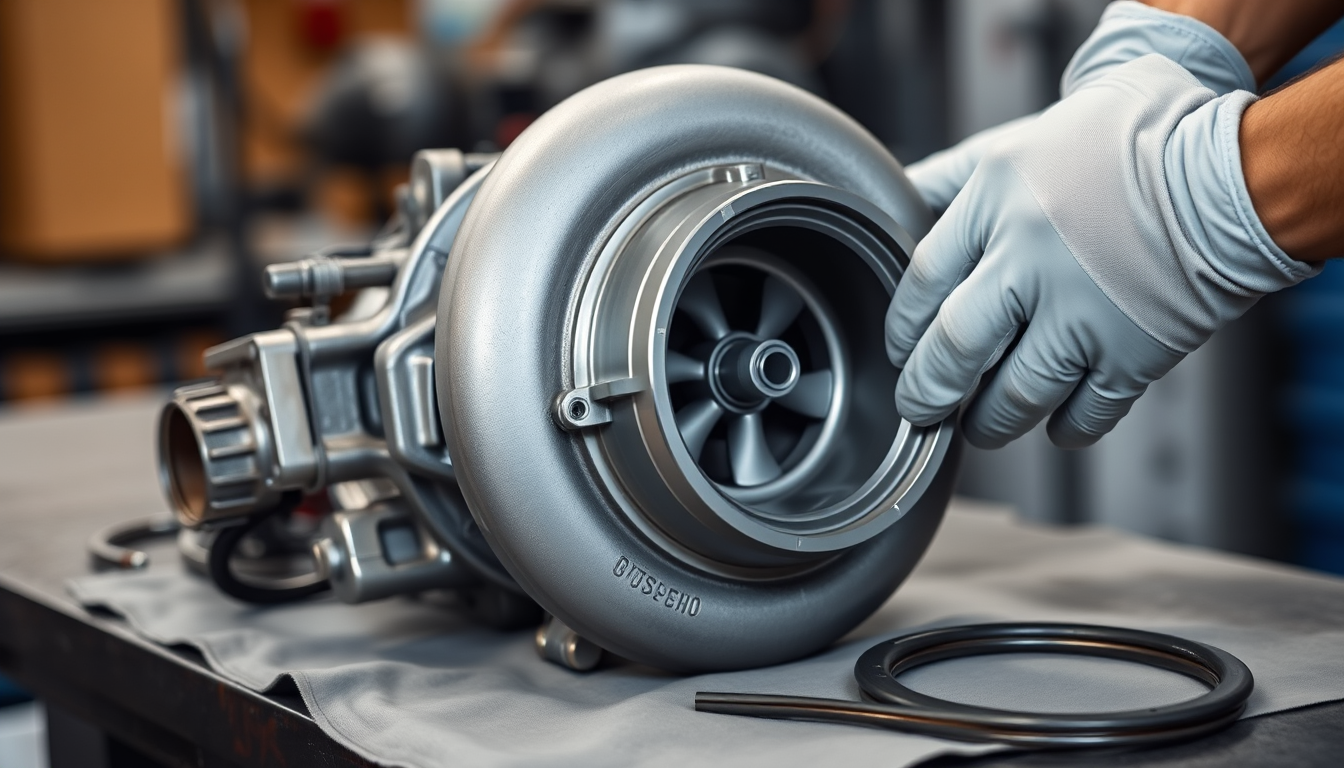
Turbo Rebuild or Replace is the question every N54 owner faces once the car starts rattling, whistling or losing boost. The honest answer is that a shop shouldn’t choose until it has looked at three things: housing damage, shaft play and the condition of the oil feed. Most guides on this are written for diesel trucks. A twin turbo BMW is a different job, so here’s how the decision actually gets made.
Key Takeaways:
- As of October 2026, Garrett Motion says “more than 90%” of turbo failures are oil related and manufacturing defects are “less than 1%” (Garrett Motion). Find the oil problem first.
- BMW’s own bulletin says a slight rattle from an early N54’s wastegate is normal and tells technicians not to replace the turbocharger for it (BMW SI B11 13 07).
- Cracked housings, damaged wheels and shaft play past the service limit point to replacement. Sound housings, clean wheels and play within spec point to repair.
- Either way, the oil lines and seals around the turbos get renewed.
Why Doesn’t a Diesel Truck Guide Fit a Twin Turbo BMW N54?
The N54 has two turbos, so every turbo decision is made twice. According to Wikipedia, the engine “has two small low-pressure turbochargers to minimise turbo lag” and was built from 2006 to 2016 (Wikipedia). BMW’s bulletin parts list shows one wastegate actuator for cylinders 1 to 3 and another for cylinders 4 to 6 (BMW SI B11 13 07).
Both turbos run on the same oil, filter and history. If one has failed, the other deserves a hard look before anyone says “just do the bad side.”
Where do the published inspection procedures come from? Mostly commercial diesel. In April 2013, Isuzu’s bulletin IB09-J-002C told technicians on its N-Series and Chevrolet and GMC W-Series trucks to check the compressor and turbine wheels for foreign object damage first, and to measure shaft play only if the wheels were clean (Isuzu, Turbocharger Inspection). The order of checks transfers to a BMW. The numbers don’t.
What Does a Shop Check Before It Condemns a Turbo?
A careful shop works in a fixed order: confirm the noise is actually the turbo, inspect the housings and wheels, measure shaft play, then judge the oil feed. Skipping the first step is how good turbos get replaced.
Is the Noise Even the Turbo?
Not always. BMW’s June 2012 bulletin covers 335i, 335xi, 535i and 535xi cars with an N54 built up to March 2008. It says a slight rattle under steady acceleration between 2,000 and 4,000 RPM comes from the rotating wastegate valve face, is “considered normal operation of the mechanical waste gate valve.” The bulletin adds, “No repair should be attempted for this type of rattling complaint” (BMW SI B11 13 07).
A harder clanking on deceleration is different. The bulletin traces it to the wastegate valve not closing completely and says “do not replace the turbocharger.” The steps start with a DME reprogram, and for the earliest cars they include new wastegate actuators if the noise remains. Your VIN’s build date decides which procedure applies.
Tomorrow’s Technician adds another cheap suspect. Wastegate rattle, slight power loss and lag-like symptoms are often caused by kinked, restricted or blocked vacuum supply hoses, and the magazine advises replacing a hose “if you have any doubt at all about its condition” (Tomorrow’s Technician, July 2024).
What Do the Housings and Wheels Tell You?
Plenty. Isuzu’s bulletin has the technician look for cracked or deteriorating turbocharger housings, heat distortion, external oil or coolant leaks and damaged or restricted oil supply and drain lines. Then it has them inspect both wheels with a light. If a wheel is damaged, a foreign object got in, and the bulletin’s instruction is to fix the source and “replace the turbocharger assembly.”
That’s the first fork in the road. A cracked housing or a chewed wheel isn’t a rebuild candidate. A clean one keeps the rebuild option open.
How Much Shaft Play Is Too Much?
It depends on the turbo, which is why a generic number is useless. Isuzu has the technician spin the shaft by hand, then use a dial gauge with 12 N of force on the compressor wheel. Its limits for two diesel engines are 0.09 mm axial and 0.14 to 0.17 mm radial. Those are Isuzu’s figures, not an N54’s.
The useful part is the logic. Isuzu’s investigation of returned turbochargers found many had been replaced for internal oil leaks when there was no fault in the turbo at all. Measuring first keeps good turbos on the car.
Why Does Oil Feed Condition Decide the Whole Job?
Because the oil system usually killed the turbo in the first place. Garrett Motion names three “turbo killers”: oil starvation, oil contamination and foreign object damage. It says blocked or leaking pipes usually cause starvation, and it warns that turbo damage “can often be a symptom of an underlying problem rather than the cause itself” (Garrett Motion).
Tomorrow’s Technician says it plainly: “The vast majority of turbo failures are caused by oil starvation or oil contamination.” It adds that some oil feed lines “may contain screens or filters inside them, which could trap metal debris and lead to oil starvation,” and it cites BMW bulletin SI B11 07 11 on restricted supply lines (Tomorrow’s Technician).
BimmerWorld’s listing for N54 oil lines says the lines “can become plugged and restricted by burnt oil residue, causing the turbochargers to overheat and fail” (BimmerWorld). That’s a parts seller’s claim, so weigh it as one, but it lines up with the other two sources.
The practical consequence is simple. Bolt a rebuilt or new turbo onto a restricted feed line and you’ve set up the next failure. The oil feed is the gate both options have to pass through.
Turbo Rebuild or Replace: When Does Each One Make Sense?
A rebuild makes sense when the damage is limited to what wears inside a sound turbo. Replacement wins when the structure itself is compromised. In plain terms, rebuilding keeps your existing housings and wheels and renews what wore inside, while replacing means fitting a different turbo.
Isuzu’s April 2013 bulletin gives the cleanest rule on record. A turbo with shaft play within specification, no turbo-related codes and a shaft that spins freely by hand “SHOULD NOT be replaced,” while a turbo with foreign object damage gets replaced as an assembly once the source is fixed (Isuzu, Turbocharger Inspection).
Points toward a rebuild or a wastegate-only repair:
- Housings are uncracked and show no heat distortion.
- Both wheels are free of damage.
- Shaft play measures within the specification for that turbo.
- The cause is found and fixed, whether that’s a restricted oil line, a bad vacuum hose or a worn wastegate component.
Points toward replacement:
- A cracked or heat-distorted housing.
- Wheel damage from a foreign object.
- Shaft play beyond the limit.
- Debris in the oil or intake system. Tomorrow’s Technician notes that after a failure, debris can reach the intercooler, intake manifold and engine, so those get inspected and cleaned.
Getting to the turbos is labor you pay for either way, so make the part decision with the housings in hand. Price depends on what the inspection finds, which is why a fair shop won’t quote one number blind.
What Gets Replaced Whichever Way You Go?
The lines and hardware around the turbos. Tomorrow’s Technician recommends replacing the turbo coolant and oil lines, cleaning the oil line connection areas on the crankcase and replacing the crush seals on banjo-bolt connections. It also says to replace the copper mounting nuts and torque the M7 and M8 nuts to 20 Nm, because “failing to torque these nuts properly will cause them to work their way loose.” BimmerWorld makes the same point on the lines: replace them “while you’re in there.”
Turbo Rebuild Near Me: What Should You Ask a Santa Clarita Valley Shop?
If you’re searching turbo rebuild near me from Valencia, Saugus, Newhall, Canyon Country, Stevenson Ranch or Castaic, ask questions that make a shop show its work. Garrett Motion advises checking all systems before replacing a turbo, because lack of power, noise, or excessive smoke or oil consumption can stem from fuel injection, air filters, the exhaust or lubrication (Garrett Motion). A good answer names the inspection, not just the price.
- Did you confirm it’s the turbo? Vacuum hoses and wastegate actuators come first on many noise complaints.
- What did the housings and wheels look like? You should be able to see the same thing.
- How was shaft play measured, and against what spec?
- What did you find in the oil feed lines?
- What’s being renewed around the turbos? Lines, seals and mounting nuts should be on the list.
R2 Motorsports is an independent European and exotic auto repair shop at 31929 Castaic Rd in Castaic. Our rule on a boost complaint is to find out why it happened before deciding what to do about it. Start with auto diagnostics, and know that our BMW service and engine repair work covers the follow-through.
If you drive a 335i, 135i, 535i or another N54 car and what you’re hearing or feeling matches the symptoms above, call R2 Motorsports at 661-251-3278 and we’ll talk it through.
Frequently Asked Questions
Does an N54 wastegate rattle mean the turbo needs replacing?
Not by itself. BMW’s June 2012 bulletin says a slight rattle at 2,000 to 4,000 RPM on early cars is normal operation, and for the clanking variant it instructs technicians not to replace the turbocharger (BMW SI B11 13 07). Check your build date and vacuum hoses first.
Is there one shaft play number for every turbo?
No. Isuzu’s bulletin lists 0.09 mm axial for two of its diesel engines and radial limits of 0.14 and 0.17 mm (Isuzu, Turbocharger Inspection). Each turbo has its own limit, so an N54 gets measured against its own specification, not a borrowed one.
Why do some replaced turbos fail again?
Often the cause was never fixed. Garrett Motion says more than 90% of turbo failures are oil related and that turbo damage can be a symptom of an underlying problem (Garrett Motion). A restricted feed line or contaminated oil will damage the next turbo the same way.
The Bottom Line
Turbo Rebuild or Replace gets decided by evidence, not habit. Sound housings, clean wheels, shaft play within spec and a clear oil feed keep a rebuild on the table. A cracked housing, damaged wheels, excess play or debris in the system send the job to replacement. Whichever way it goes, the oil lines get renewed, and the root cause gets fixed first.