

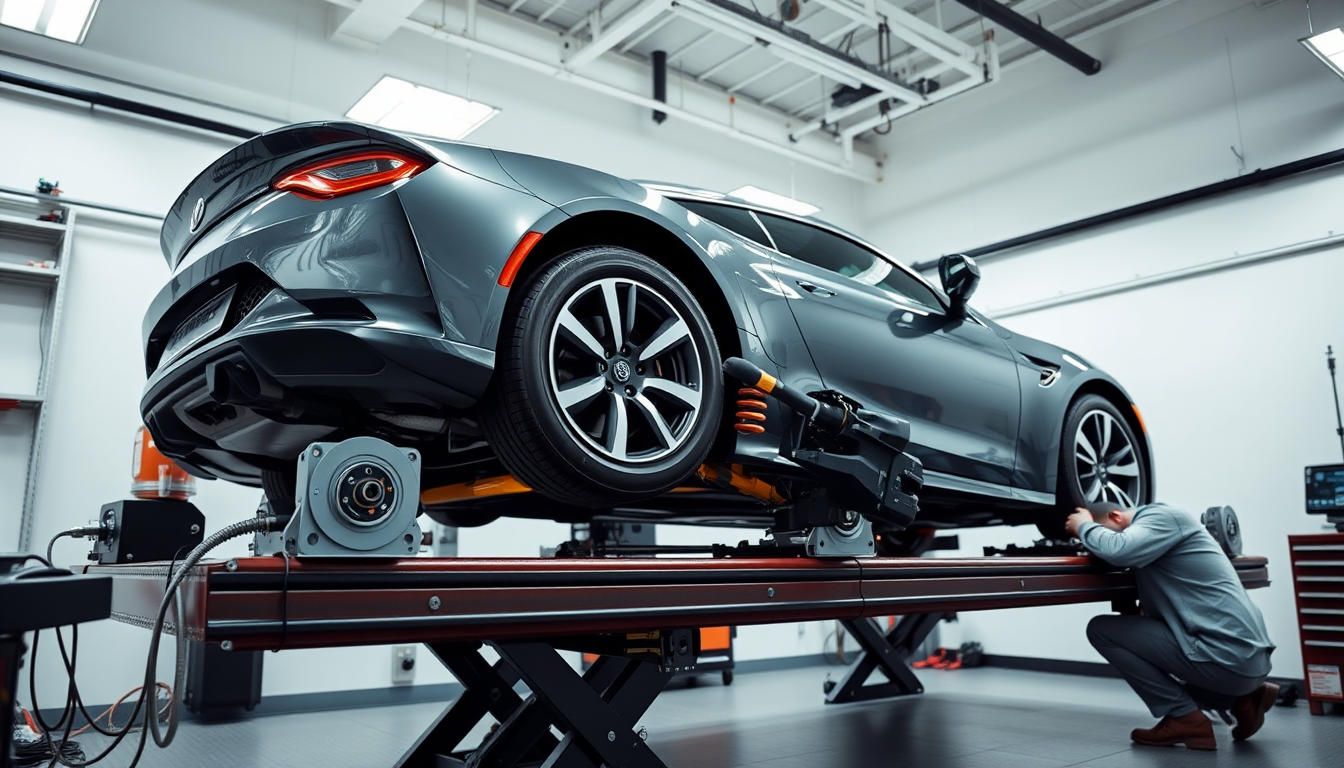
By R2 Motorsports, an independent European and exotic shop in Castaic, California. Every outside source below was checked and retrieved on October 12, 2026.
Performance Wheel Alignment on a multi-link European sports car isn’t a quick toe set. Camber, caster and thrust angle all change how the car turns in and how it tracks on the Five. The goal is a sharp front end that doesn’t make the daily drive miserable or eat a set of tires.
So what does a good setup look like for a car that gets driven hard on Sunday and commutes on Monday? This guide covers it for Porsche, BMW M, AMG, Audi RS and exotic owners in Valencia, Saugus, Newhall, Canyon Country, Stevenson Ranch and Castaic.
Key Takeaways:
- A performance alignment works inside the factory tolerance range, using “the manufacturer’s maximum negative camber, maximum positive caster and preferred toe settings” (MOTOR).
- On a multi-link suspension the arms “control camber, particularly the way that the camber changes as the wheel moves up” (Wikipedia), so a static reading is only a snapshot.
- Thrust angle sets where the rear axle points, and it can steer the front wheels off line even when front toe looks perfect.
- Street settings and track settings are different jobs. The best street setup is the one you can live with every day.
What Does a Performance Wheel Alignment Actually Change?
It moves the settings toward the aggressive end of what the factory allows, instead of the middle. MOTOR describes a standard job as aligning the wheels within manufacturer specs “for maximum tire life and directional stability.” The performance version takes advantage of the maker’s tolerance range (MOTOR).
Nobody is bending the car outside what the factory published. The same car can have a legitimate stock printout and a legitimate sport printout, and both are in spec. They just land in different places inside it. That’s also where the trade-off lives. The same MOTOR piece is blunt about it: “Track settings are for the track, street settings are for the street. Period.” Settings built for one can be “detrimental” to the other.
Why Is a Multi-Link European Chassis Different?
A multi-link suspension has “three or more control links per wheel,” and those arms manage both camber change and toe as the wheel travels (Wikipedia). Mercedes-Benz introduced it on the experimental C111 and first used it in production in the first half of the 1980s.
Here’s what that means in the bay. On a multi-link car, camber and toe aren’t fixed numbers. They move as the wheel moves. The rack gives you a snapshot at one ride height, and the tire lives in the motion between snapshots.
That’s why ride height matters so much. Lower a car on shortened springs and the camber angle changes (Wikipedia, Camber angle). On air-suspension cars, R2’s own alignment page says the work has to happen at the calibrated ride height, or the readings aren’t valid under real driving conditions (R2 Motorsports).
What Do Camber, Caster and Toe Do on the Street?
Camber, caster and toe each trade sharpness for something else. Excessive negative camber loads the inner tire shoulder (Wikipedia, Camber angle). Too much caster makes steering heavier (Wikipedia, Caster angle). Zero or toe-out front toe sharpens response at some cost to stability (Wikipedia, Toe). Here’s the short version in a table, then we’ll take them one at a time.
| Angle | What more aggressive settings give you | What they can cost you |
|---|---|---|
| Camber (more negative) | Better grip in corners | Load on the inner shoulder of the tire |
| Caster (more positive) | Directional stability and self-centering | Heavier, less responsive steering |
| Front toe (toward zero or toe-out) | Sharper response to steering inputs | Some straight-line stability |
Camber: Grip in the Corner, Wear on the Edge
Wikipedia puts it simply: “negative camber improves grip in corners,” but a suspension with excessive negative camber “places more load on the inboard shoulder of the tire” (Wikipedia, Camber angle). MOTOR’s 2025 alignment refresher agrees that excessive camber in either direction causes premature, uneven wear on the tire edges.
On the street, you’re always paying that tax. Have you ever flipped a worn tire and seen the inside edge gone while the center looks fine? That’s camber doing what you asked it to do, all day, in a straight line.
Caster: Where the Straight-Line Calm Comes From
Positive caster “improves its directional stability (reducing its tendency to wander)” and gives the steering “a degree of self-centering” (Wikipedia, Caster angle). Too much, and the steering gets “heavier and less responsive.” MOTOR also warns that too much positive caster stresses suspension components.
Here’s the catch. MOTOR notes that “most of today’s vehicles don’t have a caster adjustment” (MOTOR, 2025). On many cars you can’t simply dial it in. You work with what the car gives you, or you add parts that allow it.
Toe: The Setting That Decides How the Car Turns In
For front toe, Wikipedia says increased toe-in “provides greater straight-line stability at the cost of some sluggishness of turning response,” and that “performance vehicles may run zero front toe or even some toe-out for a better response to steering inputs” (Wikipedia, Toe). The same entry says rear toe-in provides better stability during cornering.
Small numbers, big feel. A tiny change at the front changes how eager the car is to rotate on a canyon road. A tiny change at the rear changes how settled it is while it does.
What Is Thrust Angle, and Why Does It Matter?
Thrust angle is “the angle formed by comparing the chassis geometric centerline to the rear wheel thrust line” (MOTOR, Performance Perspectives). In plain terms, it’s where the rear axle is actually pointing. If it’s off, the whole car is being pushed slightly sideways.
The same MOTOR article lists “dog tracking” as a result, where the vehicle looks crooked as it travels straight ahead. It says “a noncentered steering wheel is an indication of a probable thrust angle problem.” And it adds that “a thrust condition always causes the front wheels to steer opposite the direction of the thrust line.”
That last line is why a front-only toe set doesn’t cut it on a sporty car. Set the front perfectly to a rear axle that’s pointed the wrong way, and the car still feels off. R2’s alignment page says an out-of-spec thrust angle pulls under braking and wears the rear tires unevenly regardless of front toe (R2 Motorsports). The fix starts with measuring all four corners.
How Do You Keep Street Comfort and the Front End With a Performance Wheel Alignment?
Start from the factory range and move deliberately inside it. For daily driving, MOTOR says following factory specifications is preferred. For caster, it’s best to follow the manufacturer’s spec (MOTOR). Then add only as much sharpness as your tires and patience can take.
A practical checklist for owners:
- Tell the shop how the car is really used. Mostly commuting and the occasional canyon run is a different brief than track days.
- Ask for before and after printouts of camber, caster, toe and thrust angle. If a shop can’t show you the numbers, you can’t judge the work.
- Have it done at the correct ride height, especially on air-suspension cars.
- Ask what trade-off each change costs you in tire wear and straight-line feel before anything gets turned.
- Re-check after any suspension work, new tires or a hard curb strike.
For a car that sees mostly street miles, a mild performance bias is usually the right call. Think a bit more negative camber and a crisper toe setting, held inside the factory range. It’s the sweet spot between a stock setup and a track car you can’t drive to the grocery store.
When Should You Book an Alignment?
Book one after any suspension repair, new tires or a curb or pothole hit. Book one too when the car pulls, wanders or wears the edges of its tires. Suspension work moves the geometry, so alignment belongs in the same job. R2 Motorsports follows suspension repairs that affect wheel geometry with a four-wheel alignment (R2 Motorsports).
There’s a modern reason too. MOTOR’s 2025 article says some vehicles require an ADAS sensor recalibration, “especially if toe or thrust angle has changed” (MOTOR, 2025). Alignment isn’t just about tires anymore. It’s about what the car’s sensors think is straight ahead.
If a suspension or steering fault sits behind the symptoms, our suspension repair and steering repair pages explain what we check first.
What Should You Look for in an Alignment Shop Santa Clarita Owners Can Trust?
Look for a shop that measures all four corners, shows you before and after readings, aligns at the right ride height and talks through trade-offs first. An alignment shop Santa Clarita drivers rely on treats a Porsche, an AMG and a Range Rover as different platforms, not one generic job.
R2 Motorsports is an independent European and exotic shop at 31929 Castaic Rd in Castaic. Our wheel alignment page lays out how we handle camber, caster, toe and thrust angle across the platforms we service. Our Porsche, BMW and Mercedes pages cover the rest of the car.
On equipment, that page says R2 aligns on Hunter and John Bean racks built for low-profile tires, staggered fitments and low ride heights, and that every alignment produces a before and after printout (R2 Motorsports). It also says a performance setup is discussed with the owner before anything is adjusted, since a track-biased setup causes inside tire wear in daily driving.
If your car is pulling, wandering, wearing its tire edges or sitting with an off-center steering wheel, call R2 Motorsports at 661-251-3278. If it tracks straight and the tires wear evenly, enjoy the drive.
Frequently Asked Questions
Will a performance alignment ruin my tires?
Not by itself, but it does trade some tire life for handling. MOTOR says a standard alignment aims for maximum tire life, while a performance one uses the tolerance range for handling. More negative camber loads the inner shoulder of the tire, per Wikipedia, so expect to watch that edge.
Can I run track settings and still drive the car daily?
You can, but you’ll feel it. MOTOR says adjusting alignment for the track is detrimental for street driving, and vice versa. If the car sees both, ask for a street-biased setup inside the factory range. Treat track settings as a separate change.
What does an off-center steering wheel mean?
It may point to a thrust angle problem. MOTOR says a noncentered steering wheel is an indication of a probable thrust angle problem. A four-wheel measurement shows whether the rear axle is aimed off center, so it’s worth checking before you replace anything.
Does lowering the car change my alignment?
Yes. Wikipedia’s camber entry notes that when a car is lowered with shortened springs, the camber angle will change. On a multi-link car, toe moves too, so a lowering job should always be followed by a four-wheel alignment at the new ride height.
Sources
- MOTOR, Performance Wheel Alignment, undated magazine summary page, retrieved 2026-10-12, source
- MOTOR, The Alignment Fundamentals You Thought You Knew, by Roy Dennis Ripple, September 2, 2025, retrieved 2026-10-12, source
- MOTOR, Performance Perspectives, November 2006, retrieved 2026-10-12, source
- Wikipedia, Multi-link suspension, retrieved 2026-10-12, source
- Wikipedia, Camber angle, retrieved 2026-10-12, source
- Wikipedia, Caster angle, retrieved 2026-10-12, source
- Wikipedia, Toe (automotive), retrieved 2026-10-12, source
- R2 Motorsports, Wheel Alignment for European and Exotic Cars in Santa Clarita Valley, retrieved 2026-10-12, source