

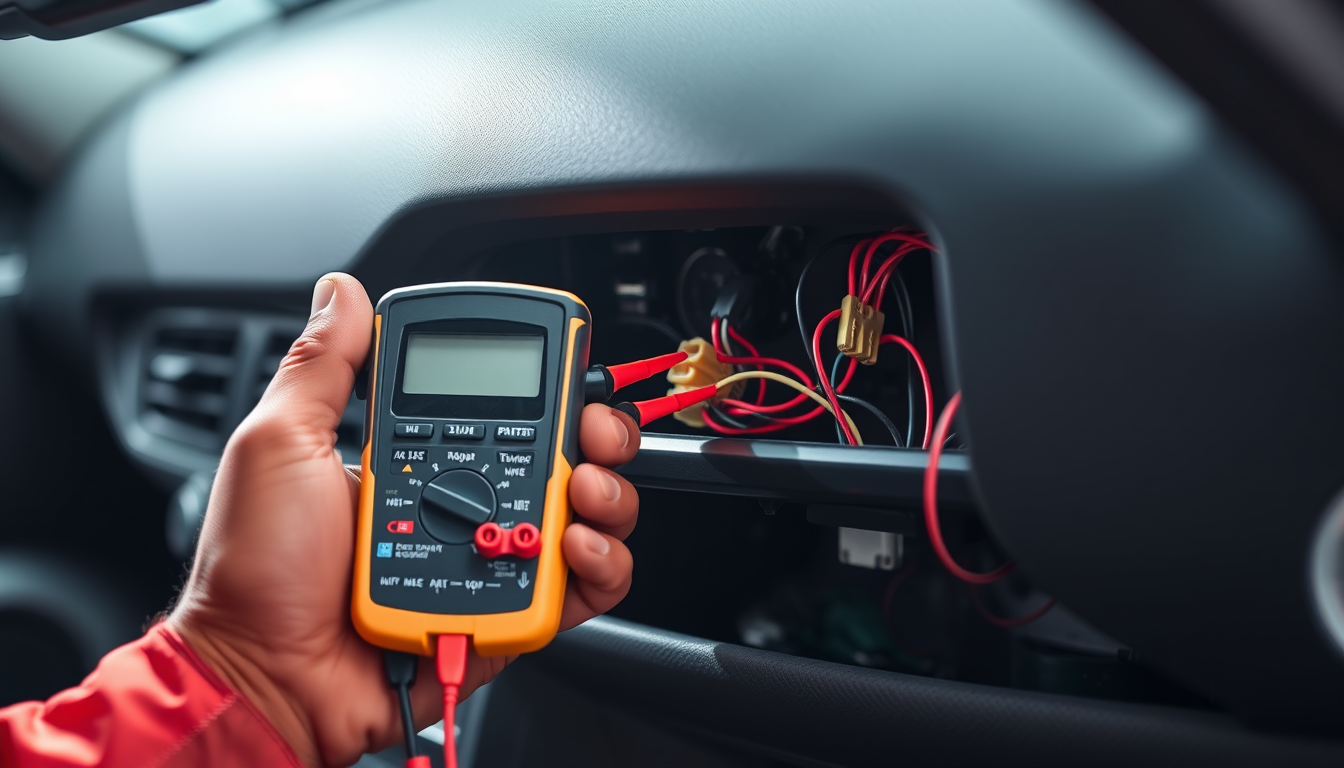
European Car Electrical Problems often show up as a wall of warning lights, not one clean message. When the airbag, ABS, suspension and engine lights all come on together, the cause can be a single fault on the shared network those systems talk over, not four separate failures. That network is the CAN bus (Controller Area Network), and one bad module, wire, connector or ground can make many healthy modules look broken.
If your Porsche, BMW, Mercedes-AMG or Audi just lit up and then went quiet, you want a shop that finds the cause instead of guessing. What’s happening behind the dash is easiest to see in real documents, so we use two Audi bulletins and a Mercedes technician’s article as the worked examples. Those are brand-specific, so the exact fixes belong to those cars. The shared-network logic is what carries over to other makes.
Key Takeaways:
- Modules share one communication bus, so a single fault can show up as many lost-communication reports (Automotive Training Centre).
- Audi’s 2013 bulletin for the 2010 to 2014 Q7 lists six warning lights that can come on together. The documented fix was CAN wiring behind the dash (Audi of America bulletin, hosted by NHTSA).
- A 2024 Audi bulletin traced a similar multi-lamp complaint to a temporary gateway module reset and said replacing the gateway “will not fix the issue, nor is it necessary” (Audi of America bulletin, hosted by NHTSA).
- Sometimes the module really is bad. A Mercedes technician traced a car with dead windows, seats and locks to one door control module by reconnecting the network one branch at a time (Steve Brotherton, Mastering Mercedes Multiplexing, 2005).
- Network faults call for isolation, one branch at a time, not a parts swap.
Why Does One Fault Light Up So Many Warning Lights?
Because modules don’t each run private wiring to the dash. They share a bus and pass messages back and forth, so when that conversation breaks, every module that depends on it reports a problem. Automotive Training Centre puts it plainly: “CAN is a shared communication bus, so one problem can affect many modules at once” (Automotive Training Centre).
The technology isn’t new. Bosch introduced CAN at an SAE congress in February 1986. Mercedes-Benz has used it in its upper-class passenger cars since 1991, according to CAN in Automation (CAN in Automation). What’s changed is how much rides on it. The 2013 Audi Q7 bulletin below lists engine, transmission, ABS, adaptive air suspension and corner view camera modules all logging CAN communication codes, so one weak link has a lot of company when it fails.
Think of it as a conference call. If one person’s phone is full of static, everyone else on the line starts to sound broken too. Which of those people is actually the problem? That’s the whole job.
What Did Audi’s Service Bulletin Say About Multiple Warning Lights?
It described a pile of warning lights and communication codes from one wiring fault, and the repair was wiring, not a module. It’s the clearest example we’ve found. Service bulletin 2034945/1, dated August 8, 2013, covers the 2010 to 2014 Q7 under the heading “Multiple warning lights illuminated; communication error DTCs” (Audi of America bulletin, hosted by NHTSA). A DTC is a diagnostic trouble code, the stored fault entry a scan tool reads from a module.
In the bulletin, a Q7 owner may report two or more of these lights at once: airbag, TPMS (tire pressure), ABS/ESP (brake and stability), engine, suspension and transmission. Communication codes may sit in the engine, transmission, ABS, adaptive air suspension and corner view camera modules. The catch is that the lights “may be sporadic, and may not be illuminated by the time the customer brings the vehicle to the workshop,” per the same Audi document.
The Fix Was Wiring, Not a Module
Audi’s technical background names “sporadic data disruption on the CAN bus wiring behind the dashboard” between two 46-pin CAN disconnect plugs. The repair is a new twisted-pair wiring overlay between those plugs, plus new terminals from a repair kit. The bulletin’s service steps don’t include replacing a control module (Audi of America bulletin).
This is one model and one documented fault from 2013. We’re not saying every Q7 or every Audi has it. It does show the pattern, though: many modules complaining, one real culprit, and an intermittent fault that vanishes before the appointment.
What Happened When an Audi Gateway Module Reset?
A gateway module that reset itself, with nothing needing replacement. Eleven years after the Q7 bulletin, Audi documented the “failed module” version of this story, and the failure turned out to be temporary. Technical service bulletin 2075405/1, dated September 27, 2024, covers 2024 models including the S5, RS 5, RS 6 Avant, RS 7, S8, SQ7 and RS Q8 (Audi of America bulletin, hosted by NHTSA). Drivers saw various warning lamps while driving, and the side windows could lower on their own.
The bulletin says intermittent CAN and FlexRay faults were logged in various control units. All the symptoms and event memory entries “indicate a temporary failure of the gateway J533.” Under certain conditions, Audi says, a data collection campaign can cause an intermittent reset of that gateway module. The service measures were to stop those campaigns and, when the concern occurs, to turn terminal 15 off and back on.
The bulletin lists new gateway software for the J533 as of week 25 of 2025 (model year 2026), so check current Audi service information for your car’s status. It also states that “replacing the gateway J533 diagnostic address 0019 will not fix the issue, nor is it necessary,” and that functions return after about 30 seconds (Audi of America bulletin).
So the “one module lights up the dash” idea is real, but the cure wasn’t a new module. It was a software and process change. A technician who ordered the part would have spent the customer’s money and still had the same car.
Common Causes of European Car Electrical Problems on a CAN Network
The sources we cite point to four suspects: a module, wiring or a connector, a shared ground, or low voltage. A failed module is only one of them, and good car electrical repair doesn’t assume which one it is.
| Possible cause | What the sources describe | Where a technician looks first |
|---|---|---|
| Module fault | A short or open “is either within that module or others connected directly to it” (Fleet Maintenance) | Which modules still communicate |
| Wiring or connector | Corrosion, backed-out pins and harness strain near common rub points (Automotive Training Centre) | The harness and its connectors |
| Shared ground | A shared ground problem “can cause multiple failed modules” (Automotive Training Centre) | Ground points that feed several modules |
| Low voltage | Can trigger “network instability and module resets” (Automotive Training Centre) | Battery health and charging voltage |
A Failed or Misbehaving Module
A module can fail internally and disturb traffic for its neighbors. In a Ford police car walkthrough (not a European platform, but the same layered-network logic), Fleet Maintenance notes that “there are other modules connected to the PCM through the ABS module” (Fleet Maintenance). The PCM is the powertrain control module. So the module reporting the code may only be the one that noticed.
Sometimes the module really is the culprit, and a Mercedes example shows how to prove it. Technician Steve Brotherton described a 1999 E430 (210 chassis) whose windows, seats, locks and sunroof were all inoperative. The scan tool showed the body CAN status as “instable” with none of the modules online. He pulled the twisted pairs off the bus bar and reconnected them one at a time until the network went unstable again, and the module list then showed the right rear door control module offline. Replacing that door control module repaired the car (Steve Brotherton, Mastering Mercedes Multiplexing, 2005).
Wiring, Connectors and Grounds
Water getting in, corrosion, pins that have backed out of a connector and strain on a harness all rank as common culprits (Automotive Training Centre). That same Ford walkthrough describes a case where an upfitter’s add-on tapped into a speed sensor circuit and left the CAN communication wires damaged and touching, creating a short (Fleet Maintenance).
Wiring damage isn’t always gradual, either. Here’s a job from our own bay, an Audi S5 whose wiring was destroyed by rats.
Physical harness damage is one more way a single event can show up as many symptoms. The dashboard shows symptoms, not locations.
Low Voltage
Don’t skip the battery. Low voltage can trigger network instability and module resets, which is why Automotive Training Centre lists battery health and charging voltage as a first check (Automotive Training Centre). Brotherton gives the same advice for Mercedes: when stored lost-communication codes turn up in several modules with no current symptoms, “I usually suspect the battery” (Steve Brotherton, Mastering Mercedes Multiplexing, 2005). It’s a quick test. It can also save a long chase.
How Does Car Electrical Repair Find the Real Fault?
By isolating the network in steps instead of replacing whatever module is shouting loudest. Fleet Maintenance, in that Ford walkthrough, argues that wiring, multiple modules and mechanical systems all have to be ruled out. It also says a complete picture of the communication network map is essential (Fleet Maintenance).
Automotive Training Centre adds the practical half. How do you actually narrow it down? You disconnect modules or branch connectors strategically, following the manufacturer’s service information, and the moment the bus behaves again you’ve narrowed it to a branch or module (Automotive Training Centre).
A sound sequence built on those two sources looks like this:
- Read the stored codes from every module, not just the one that triggered the light.
- Check battery health and charging voltage.
- See which modules can still communicate, and how they connect to each other.
- Inspect the harness and connectors along the suspect branch.
- Isolate branches or modules one at a time, following the manufacturer’s service information, until the bus returns to normal.
Is that slower than swapping a part? Yes. But a part swap that misses the real fault costs you twice. It’s the same logic behind our auto diagnostics service for European and exotic cars that arrive with a dashboard full of lights.
What Should You Tell Your Shop About an Intermittent Warning Light?
Your description is evidence, because the lights can be gone by the time you arrive. If the airbag, ABS or stability lights were among them, don’t wait for the fault to repeat before getting the car looked at. What helps most:
- Which lights came on. A group of unrelated lights at once points at the network.
- What the car was doing when it happened: starting, braking, hitting a bump, or sitting overnight.
- Any recent work. A new battery, an aftermarket install or a body repair can disturb wiring or voltage, and that includes anything tapped into an existing circuit.
- Storage. Parked outside or stored a while?
- Photos or video of the dash, if you can safely grab them.
If you’re driving in from Valencia, Saugus, Newhall, Canyon Country or Stevenson Ranch and the lights cleared on the way, bring the story anyway. That’s exactly the sporadic behavior the Audi bulletin describes. Wouldn’t you rather hand over a clear timeline than hope the fault repeats on the lift?
Frequently Asked Questions
Why do several unrelated warning lights come on at once?
Modules share a communication bus, so one fault can make many of them report lost communication (Automotive Training Centre).
Does a lost-communication code mean that module is bad?
Not necessarily. In the Audi Q7 bulletin, codes appeared in five different modules, and the documented fix was new CAN wiring behind the dash (Audi of America bulletin).
Can a weak battery cause European car electrical problems?
Yes. Low voltage can trigger network instability and module resets, so battery health and charging voltage get checked first (Automotive Training Centre). A Mercedes technician says he suspects the battery when stored communication codes show up in several modules with no current symptoms (Steve Brotherton, Mastering Mercedes Multiplexing, 2005).
Why did my warning lights go away before the appointment?
Network faults can be intermittent. The Audi bulletin says the lights may not be on when the car reaches the shop (Audi of America bulletin), which is why stored codes and a detailed description matter.
The Bottom Line on European Car Electrical Problems
A dashboard full of lights can be one conversation gone wrong, not a car falling apart. Problems like this may come down to a module, a harness, a connector, a ground, a battery or even a software reset, and isolating the network beats guessing. That’s the whole point of proper car electrical repair. If your Porsche, BMW, Mercedes or Audi has thrown several unrelated warning lights and you’re still chasing the cause, give R2 Motorsports a call at 661-251-3278 and tell us what the car did.