

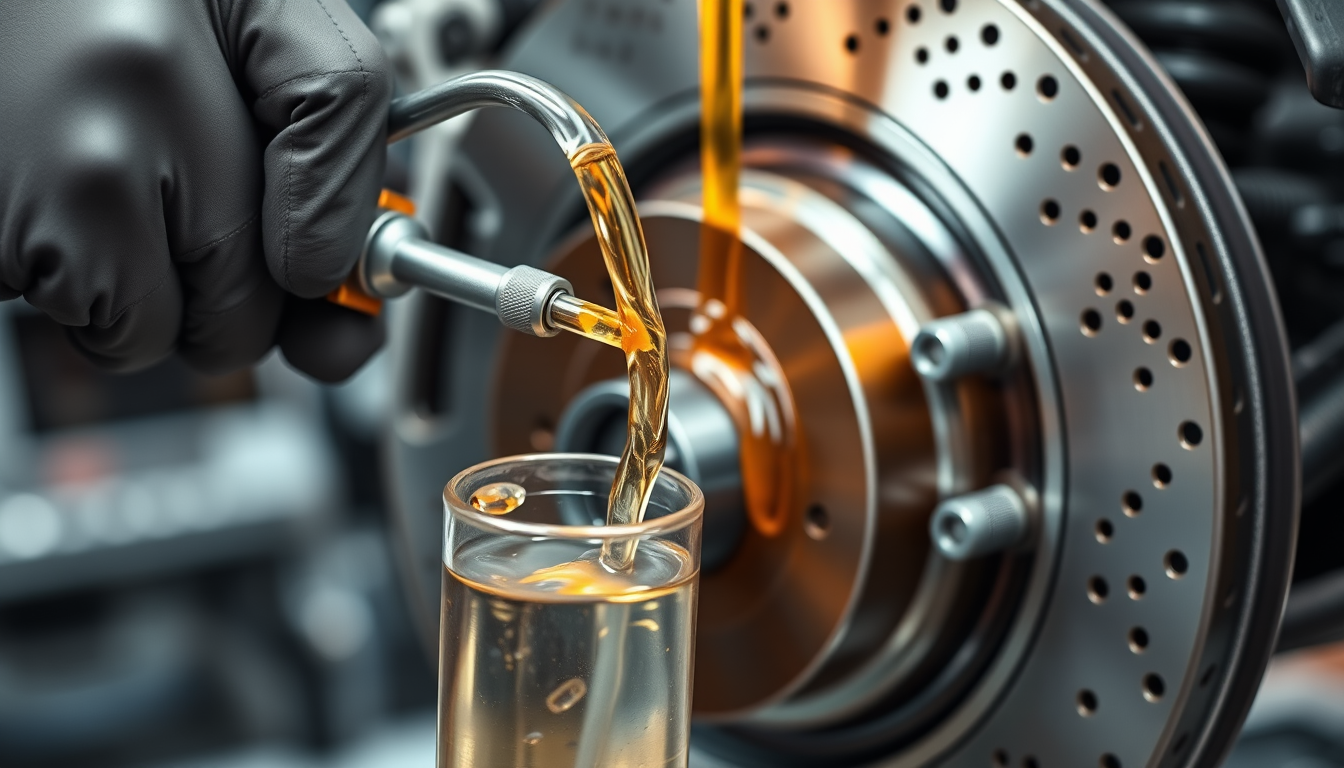
A Brake Fluid Flush isn’t something you schedule by odometer. Brake fluid absorbs moisture whether your Porsche, AMG, or Range Rover covers 20,000 miles a year or sits in the garage. What matters is how much water the fluid holds and how hot your brakes get. Here’s how we think about the brake fluid exchange interval for performance European cars.
Key Takeaways
- Under federal standard FMVSS 116, DOT 4 fluid must boil at 230°C (446°F) or higher when new, but only 155°C (311°F) or higher when “wet” (Source).
- Fluid ages with time and heat, not just miles. Check your factory schedule first, then shorten it if you drive hard.
- Testing or replacing fluid before a track day or a long mountain run is cheap insurance.
Why Doesn’t Mileage Set the Brake Fluid Exchange Interval?
In 2015, Tilton Engineering’s Daniel Fuentes wrote that DOT 3 fluid tends to absorb 1 to 2 percent water in one year, and that contamination occurs whether a car covers more than 20,000 miles a year or just sits in the garage (Tilton Engineering, “Brake Fluid: Stay Safe And Go Fast,” Source). Water content follows time and exposure, so mileage alone can’t set the interval.
The same article says DOT 4 absorbs moisture quicker and must be replaced more often. Wikipedia’s brake fluid entry adds that glycol-ether fluids (DOT 3, 4, and 5.1) “absorb moisture from the atmosphere under normal humidity levels” (Source). Brake fluid is hygroscopic, meaning it pulls water out of the air.
So why do so many owners still ask “how many miles?” Because oil changes taught everyone to think in miles. Brake fluid doesn’t wear out from friction. It ages in the reservoir and lines, which means a garage-kept exotic with low mileage can still be carrying old, wet fluid.
What Do Wet and Dry Boiling Points Actually Mean?
Under FMVSS 116, DOT 4 fluid must boil at 230°C (446°F) or higher when dry but only 155°C (311°F) or higher when wet, a 75°C (135°F) drop once humidified to 3.70 percent water by weight (U.S. eCFR, 49 CFR 571.116, retrieved 2026-10-26, Source). Dry describes fresh fluid. Wet describes fluid that has been in service.
DOT 3 versus DOT 4 minimums
According to the 2026 eCFR text of FMVSS 116 (U.S. Government Publishing Office, 49 CFR 571.116, retrieved 2026-10-26), the DOT 3 and DOT 4 minimums are below. The DOT 5.1 row comes from the Wikipedia “Brake fluid” table (retrieved 2026-10-26), which cites the same federal rule.
| Fluid | Dry boiling point (minimum) | Wet boiling point (minimum) | Drop, dry to wet |
|---|---|---|---|
| DOT 3 | 205°C (401°F) | 140°C (284°F) | 65°C (117°F) |
| DOT 4 | 230°C (446°F) | 155°C (311°F) | 75°C (135°F) |
| DOT 5.1 | 260°C (500°F) | 180°C (356°F) | 80°C (144°F) |
The last column is our own subtraction from the published minimums. The pattern is clear. Every grade loses a big slice of its thermal margin once it’s wet, and a higher-grade fluid still has a wet number well below its dry number.
Why does a few percent of water matter so much? Wikipedia’s brake fluid entry explains that boiling fluid forms vapor, and “vapor is highly compressible relative to liquid,” so hydraulic force no longer transfers and the brakes can fail to stop the car (Source). A pedal that sinks toward the floor on the third hard stop is the classic symptom.
How Does Heat Change a Performance Car’s Brake Fluid Flush Schedule?
In 2015, Tilton Engineering’s guidance for track drivers was to replace brake fluid at least once a year and to test or change it after every track outing, because a car driven hard keeps its fluid hot (Tilton Engineering, Source). Heat, not mileage, is what shortens a performance car’s schedule. That’s motorsport guidance, and it’s the right reference for a car that sees real heat.
Think about what our owners actually ask of their brakes. A 992 or a McLaren on a canyon run. A Corvette on a spirited weekend. An AMG or Range Rover hauling a heavy body down a long grade. Each of those puts repeated heat into the calipers, and the fluid sitting in them carries whatever water it has already absorbed.
Here’s the practical split we use in the bay:
- Street-only, gentle use: follow the factory time-based schedule and don’t stretch it.
- Spirited road driving: go shorter than factory and test the fluid between services.
- Track days or driving school: flush before the season, check after every event, and consider a higher-spec fluid.
Notice what’s missing from that list. Mileage. A car that sees a few track weekends a year but little road mileage can need more attention than a high-mileage commuter.
Where Do Factory Schedules Fit?
Factory schedules are the baseline. Your owner’s manual or service booklet lists the brake fluid interval for your model and year, and that’s the authoritative answer. We follow each manufacturer’s published service requirements, not estimates. Because fluid takes on water with time, treat that interval as a calendar item, not a mileage item.
We don’t quote a single number for every brand here, because intervals differ and we won’t guess. What we will say is that the factory number assumes normal use. If you drive harder than a normal owner, treat the factory interval as a ceiling rather than a target.
Our own stated policy is simple. R2 Motorsports recommends brake fluid replacement on a two-year cycle regardless of mileage for any European or exotic car driven enthusiastically (R2 factory scheduled maintenance page). We also test moisture content at every major service and advise from the result, so you aren’t guessing about fluid you can’t see.
If you’re not sure what your car calls for, our factory scheduled maintenance service follows the manufacturer’s procedure. For brand-specific questions, see our Porsche service, BMW, Mercedes, and Audi pages.
Which Fluid Grade Belongs in Your Car?
Under FMVSS 116, DOT 4 must hold 230°C (446°F) dry and 155°C (311°F) wet, while DOT 3 is held to 205°C (401°F) and 140°C (284°F) (U.S. eCFR, 49 CFR 571.116, retrieved 2026-10-26, Source). Use the grade your manufacturer specifies, and consider an upgrade only if your driving justifies it.
Here’s the thing most owners miss. A higher dry number on the label can look impressive, but the wet number is the one you’ll actually live with after a year or two in service. Compare wet boiling points when you shop, and ask what the fluid’s published figures are before you buy.
Never assume two fluids can be mixed or swapped. Check the specification printed on the reservoir cap or in the manual. On an AMG, for example, DOT 4 LV is not interchangeable with standard DOT 4, and mixing them affects system response. That’s why we stock DOT 4, DOT 4 LV, and DOT 5.1 and use the correct spec for your car, not whatever is on the shelf (R2 brake repair page). If your car carries an exotic or carbon-ceramic setup, that’s a conversation for a technician, not a parts-store shelf. Our exotic auto repair team handles those systems.
What Does a Proper Brake Fluid Flush Involve?
A proper flush replaces the old fluid at every caliper, not just at the reservoir. We follow the manufacturer’s bleeding procedure for your platform, and we use the correct fluid spec for the car. Some platforms call for a scan tool to reach the ABS pump or enter a service mode so the whole system gets fresh fluid, which is why our shop runs factory-grade diagnostic equipment with full module access. We quote the full job before anything comes apart, and if we find additional issues, we call you first.
Why not just top off? Because topping off adds a little new fluid to a lot of old fluid. The water stays in the lines and calipers. A real exchange pushes the aged fluid out, and that’s the only way to restore your original boiling point margin.
If your pedal already feels soft, or the car has a brake warning, don’t wait for the next interval. That calls for an inspection, and our brake repair service covers it. A warning light with no obvious cause may also need our auto diagnostics.
When Should You Call R2 Motorsports?
Call when your car matches the picture above. That means a performance European or exotic that sees canyon roads, track days, or heavy loads, and fluid whose age you can’t prove. If that’s your car, R2 Motorsports in Castaic serves Valencia, Saugus, Newhall, Canyon Country, Stevenson Ranch, and the wider Santa Clarita Valley at 661-251-3278.
If your car is a garage-kept weekend driver on a fresh factory-interval flush, you probably don’t need us yet. We’d rather you wait than pay for work you don’t need.
Frequently Asked Questions
How often should I do a Brake Fluid Flush on a performance car?
Start with the factory time-based schedule in your manual, then shorten it for hard driving. Tilton Engineering advises replacing fluid at least once a year for track use and testing or changing it after every track outing (Tilton Engineering, 2015). Street cars should follow the factory interval.
Does brake fluid go bad if the car sits?
Yes. Tilton Engineering says contamination can occur whether a car is driven more than 20,000 miles a year or just sits in the garage (Tilton Engineering, 2015). Moisture works its way in over time, so a garage queen still needs a time-based brake fluid exchange interval.
What is the difference between wet and dry boiling point?
Dry boiling point is for fresh fluid. Wet boiling point is for fluid that has absorbed water. Under FMVSS 116, DOT 4 must reach at least 230°C (446°F) dry and 155°C (311°F) wet, and the wet test uses fluid humidified to 3.70 percent water by weight (49 CFR 571.116).
Can I just top off the reservoir instead of flushing?
No. Topping off leaves the aged, water-laden fluid in the calipers and lines. Only a full exchange removes it. If your pedal feels soft or you see a brake warning, have the system inspected rather than adding fluid.
Sources
- U.S. Government Publishing Office, eCFR, 49 CFR 571.116 (FMVSS No. 116), retrieved 2026-10-26: Source
- Tilton Engineering, “Brake Fluid: Stay Safe And Go Fast,” Daniel Fuentes, February 23, 2015, retrieved 2026-10-26: Source
- Wikipedia, “Brake fluid,” boiling point table and hygroscopic behavior, retrieved 2026-10-26: Source