

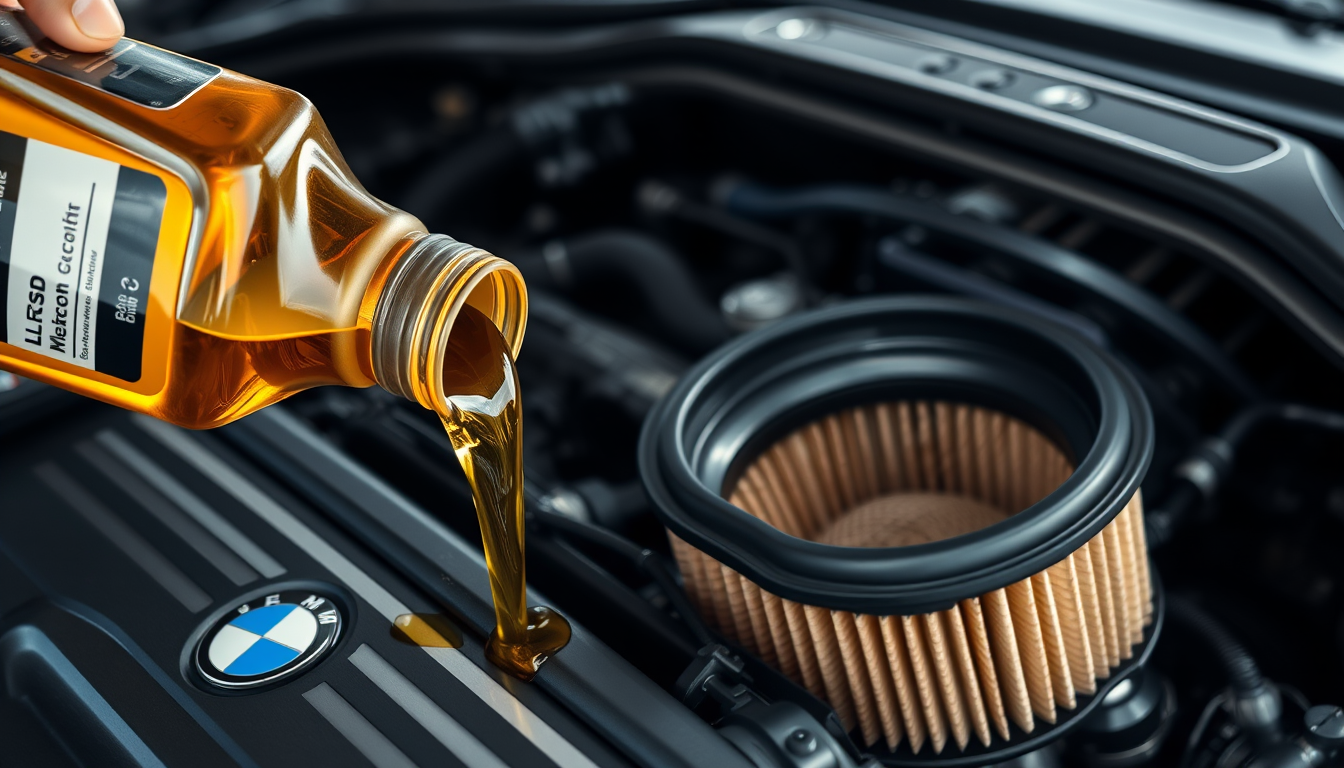
BMW Oil Change Cost isn’t one number. A shop that quotes a single figure for every BMW is skipping the part that matters. A turbocharged four, a B58 six, an S58 in an M3 and an N63 V8 hold very different amounts of oil. Each one is built around a specific factory approval. Capacity and approval set the bill. The name on the door comes second.
If you’ve priced a bmw oil change at a quick lube, a dealer and an independent specialist and watched the quotes scatter, this is why. Here’s what’s actually driving it.
Key Takeaways:
- As of October 2026, BimmerWorld lists about 5.5 quarts for its B48 four-cylinder kits, 7.4 quarts for the S58, and 9 to 9.5 liters for the N63 V8, so the oil alone scales with the engine (B48, S58, N63).
- BMW’s oil approvals are not interchangeable, and the page at oilspecifications.org says the 0W-20 LL-17 FE+ spec “isn’t suitable for every BMW or M engine” (oilspecifications.org). Its explainer adds that the standards “are not universally interchangeable” (oilspecifications.org).
- Two engines can share a code and still need different oil. FCP Euro says the newer LL-22 FE++ oil is “not backward compatible with older engines” (FCP Euro).
- The right questions to ask any shop are which approval, which filter and how the level gets set.
Why Does the Engine Set BMW Oil Change Cost More Than the Shop?
Oil volume alone changes a lot between BMW engines. As of October 2026, BimmerWorld lists approximately 5.5 quarts for the B48 four-cylinder (BimmerWorld), 7.4 quarts for the S58 (BimmerWorld) and 9 to 9.5 liters for the N63 V8 (BimmerWorld).
Think about what that means at the counter. A single menu-board price can’t cover a four-cylinder X1 and a V8 X5, because the second one needs far more oil and a filter and approval of its own. Has anyone ever explained that when they handed you the quote?
| Engine family | Fitments named in the listing | Listed capacity | Oil noted in the listing |
|---|---|---|---|
| B48 turbo four | X1 and X2 28i and M35i | About 5.5 quarts (BimmerWorld) | 0W-20, “the same weight that BMW recommends” |
| B58 turbo six | G30, G12, G05, G06 and G07 chassis | About 6.5 liters (BimmerWorld) | BMW 0W-20 LL-17 FE for 2016 to 2023 cars without the 48V mild-hybrid system |
| S58 M engine | G80 M3, G82 M4, G87 M2, F97 X3 M, F98 X4 M | 7.4 quarts (BimmerWorld) | 5W-30 kit oil measured against BMW LL-01 |
| N63 V8 | Early N63 and N63TU | 9 liters and 9.5 liters (BimmerWorld) | 5W-30 kit oil measured against BMW LL-01 |
Mixed units are part of the confusion. If you think in metric, 7.4 quarts is roughly 7 liters. So the S58 sits close to the B58, while the N63 needs a couple of liters more than either. Those listings are parts-seller figures, and your owner’s manual or VIN-specific service data is the final word on your car.
What Is a BMW Oil Approval, and Why Does It Change the Price?
A BMW Longlife approval is BMW’s own pass-or-fail rating for an oil, and the codes aren’t interchangeable. According to oilspecifications.org, LL-01 and LL-01 FE target gasoline engines without a particulate filter, LL-04 is a low-SAPS spec for particulate filters, and LL-14 FE+ and LL-17 FE+ are 0W-20 grades for selected engines (oilspecifications.org).
So why should a code on a jug change what you pay? That’s the second driver behind the quote. An oil that carries your engine’s approval is a different product from a bulk jug that doesn’t, and a filter built for your engine isn’t a generic one. Both are real parts on the invoice. Neither shows up in a flat “BMW oil change” price.
LL-01 and LL-01 FE: The 0W-30 Family
Per oilspecifications.org, LL-01 covers 0W-30, 0W-40, 5W-30 and 5W-40 grades. LL-01 FE is the fuel-economy version, listed as 0W-30, with “lower high-temperature, high-shear viscosity” (oilspecifications.org). The site’s explainer cautions against swapping a lower-viscosity FE oil in for LL-01 unless BMW specifically permits it (oilspecifications.org). Published grade lists vary a little between sources. That’s one more reason to go by your manual.
LL-17 FE+ and Newer: Thin Oil, Narrow Fitment
LL-17 FE+ is a 0W-20 spec for selected gasoline engines from model year 2014 (oilspecifications.org). Newer still, FCP Euro says LL-22 FE++ is “specified for the latest Gen 3 B58 and B48 engines with the mild-hybrid tech.” It is “not backward compatible with older engines” (FCP Euro).
Read that twice. Same engine code, different oil, depending on whether your car has the 48V system. Could a menu-board price ever capture that? FCP Euro is blunt about the downside: “using the improperly specified oil can damage the engine system” (FCP Euro).
Does the Shop You Choose Still Matter?
Yes, just not in the way the price comparison suggests. The shop decides whether the approval, filter and fill level get matched to your engine. BimmerWorld’s N63 listing says to fill about 8.5 quarts, not the full 10 quarts in the kit. Then test drive, check the level and add only if iDrive asks for it (BimmerWorld).
That’s a fill procedure, not a pour. Emptying the whole kit and walking away can leave a V8 overfilled. The electronic level check is how you confirm it either way. Short hops around Valencia in summer heat make a correct level worth the extra few minutes.
Interval is the other piece. BimmerWorld notes that LL-01 is a LongLife spec approved for extended changes, yet it “always recommends preventative oil changes in the 5,000 to 6,500 mile range” (BimmerWorld). That’s one parts seller’s recommendation, not BMW’s schedule. But it shows why “how often” belongs in the same conversation as “how much.”
What Should You Ask Before You Approve a BMW Oil Change?
Ask for the parts line by line, because BMW Oil Change Cost only makes sense when you can see what’s in it. BimmerWorld’s B58 package, for example, lists 7 liters of BMW 0W-20 oil for an engine that takes approximately 6.5 liters, plus a BMW filter kit (part number 11427826799) with the cap O-ring and drain plug crush seal (BimmerWorld). A real quote can be broken down like that.
- Which approval does my engine call for? The answer should match your owner’s manual, not a general “synthetic.”
- Does my car have the mild-hybrid system? On a Gen 3 B58 or B48 that can change the oil.
- Which filter and seals are going in? The O-ring and drain plug seal belong on the list.
- How is the level set? You want it confirmed with the car’s electronic level check, not eyeballed.
Any independent shop, dealer or quick lube should be able to answer those four. What if the answers get vague? Then the quote probably is too.
How Does R2 Motorsports Handle a BMW Oil Change in Santa Clarita?
R2 Motorsports is an independent European and exotic auto repair shop at 31929 Castaic Rd in Castaic, serving owners in Valencia, Saugus, Newhall, Canyon Country and Stevenson Ranch. Our approach to a BMW oil change is simple: identify the engine, match the approval, then fill to the correct level. It’s the same method on every BMW we service, from a four-cylinder X1 to an M car. That’s why we treat oil changes as a platform-specific service rather than a commodity.
An oil change is also the cheapest chance to look the car over. Fold it into your factory scheduled maintenance and you’re checking the right boxes at the right time, instead of paying for the same lift twice. If a warning light or a low-level message shows up during the visit, that’s a job for proper auto diagnostics, not a guess.
Frequently Asked Questions
Why do BMW oil change quotes differ so much?
Capacity and approval differ by engine. BimmerWorld lists about 5.5 quarts for a B48 and 9 to 9.5 liters for an N63, and each engine needs oil that meets its own BMW approval, so one flat price can’t fit both (BimmerWorld).
Does a BMW M car need different oil from a standard BMW?
The engine is different, so check. BimmerWorld lists 7.4 quarts for the S58 and about 6.5 liters for the B58, and measures its S58 kit oil against LL-01 (BimmerWorld). Confirm the approval in your manual before buying oil.
Can I use any 0W-20 in my B58?
No. 0W-20 isn’t one approval. LL-17 FE+ is limited to selected engines (oilspecifications.org), and the same explainer notes that “a newer specification is not automatically suitable for an older engine” (oilspecifications.org). Newer mild-hybrid B58 and B48 engines use LL-22 FE++, which FCP Euro says is not backward compatible (FCP Euro).
How often should a BMW oil change happen?
Follow your owner’s manual first. As a reference point, BimmerWorld says it recommends preventative changes every 5,000 to 6,500 miles even on LongLife-approved oil (BimmerWorld). Heat and short trips argue for the shorter side.
The Bottom Line
The shop matters, but the engine sets the floor, and that’s the core of BMW Oil Change Cost. Oil volume, the approval your engine requires and the filter that goes with it are what move a BMW oil change from one quote to the next. If you drive a B58, S58 or N63 and aren’t sure which approval your car needs, give R2 Motorsports a call at 661-251-3278. We’ll sort it out from the engine code.