

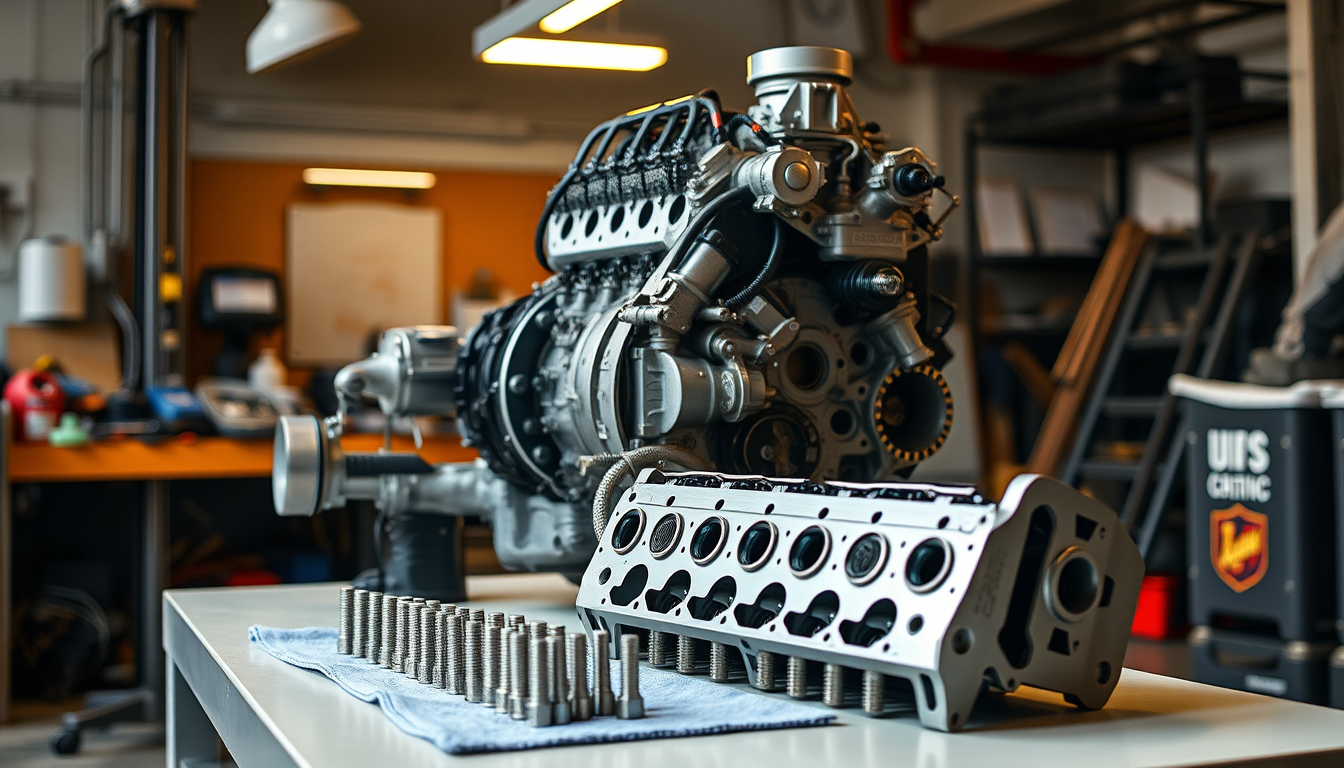
By R2 Motorsports, an independent European and exotic shop in Castaic, California. Every source below was checked and retrieved on September 28, 2026.
An AMG M156 Head Bolt failure rarely announces itself. It usually shows up as a “top up coolant” message, a rough idle, or a check engine light that comes back after you clear it. On the 6.2 V8, that small coolant loss can mean a cylinder head bolt has snapped. Catch it early and the repair stays in the top end. Wait, and it can reach the pistons and rods.
So how do you tell a head bolt problem from an ordinary coolant leak? And what should a shop check before anyone pulls a cylinder head? That’s what this guide covers, for C63, E63, S63 and other M156 owners across Valencia, Saugus, Newhall, Canyon Country, Stevenson Ranch and Castaic.
Key Takeaways:
- Early M156 engines have cylinder head bolts that “have the propensity to break at the bolt head, allowing coolant to enter the combustion chamber” (FCP Euro, 2019).
- Engines with serial number 60-060658 and later are not affected, so your engine serial number matters more than your model year.
- Low coolant, misfires, coolant in the oil and a check engine light are the classic early signs.
- A cooling system pressure test, a combustion gas test and a look at the bolts themselves should come before any teardown.
What Is the AMG M156 Head Bolt Problem?
The M156 is Mercedes-AMG’s naturally aspirated 6,208 cc V8, badged “6.3” as a nod to the old M100 (Wikipedia). Its original cylinder head bolts can break, which drops clamping force on the head gasket and lets coolant find its way into places it doesn’t belong.
CarBuzz, writing in May 2026, describes the failure as stretching, corrosion and cracking that reduce clamping force and compromise the head gasket seal (CarBuzz). Mercedes-Benz addressed it with a technical service bulletin, and CarBuzz notes it was not a recall. That distinction matters. There was no letter in the mail telling owners to come in.
A shop write-up from Renn Haus shows what it looks like on the bench: a bolt with its head missing, snapped at a recessed design that lacked strength (Renn Haus). Once a bolt lets go, the joint it was holding loses its margin. Coolant seeps. Combustion pressure pushes back. The car tells you about it slowly at first.
One honest limit on this article. We did not have the text of the Mercedes-Benz bulletin itself, so we don’t quote its wording or its number. What you’re reading rests on the parts suppliers, press coverage and shop reports cited below. Ask your technician to pull the current factory bulletin for your VIN before any work is quoted.
Which AMG Models and Engines Are Affected?
FCP Euro lists the affected cars as 2007 to 2011 E63, ML63, CLS63, S63, CL63 and R63 models, 2008 to 2015 C63 models, and 2007 to 2009 CLK63 models (FCP Euro, 2019). The dividing line is engine serial number 60-060658. Engines at or above that number are not affected. FCP Euro says the serial number is on a white sticker on the left valve cover.
Why go by serial number instead of year? Because the sources don’t agree on when the running change happened. CarBuzz says the revised design arrived “somewhere mid-way through 2011,” while a poster on MBWorld put the cutoff closer to mid-2010. A C63 is a good example. The model ran for years, and the engine in yours could be either version.
FCP Euro’s advice is direct: don’t trust records alone. Its 2019 article recommends removing the valve covers and physically verifying which bolts are in the engine (FCP Euro).
What Are the Early Warning Signs of M156 Head Bolt Failure?
FCP Euro names four early signs: a low coolant light, misfires, coolant in the oil and a check engine light (FCP Euro, 2019). The service bulletin complaint list adds stalling and rough running, per CarBuzz. Most owners notice the coolant first, then dismiss it.
Renn Haus describes the pattern as “engine misfiring and unexplained coolant loss” (Renn Haus). Unexplained is the key word. No puddle under the car. No wet hose. The coolant is leaving through the engine, not around it.
Once coolant reaches a cylinder, combustion suffers, and white smoke from the exhaust suggests coolant is entering the combustion chamber (Wikipedia, Head gasket). One MBWorld poster described low-water warnings, then a check engine light about 30 seconds later, then a rough-running car putting out a smoke screen. Sound familiar? Don’t keep topping off and hoping.
How Does a Specialist Confirm It Before the Heads Come Off?
A specialist confirms it by stacking evidence, not by guessing from one symptom. Start with the coolant history, then a pressure test, a combustion gas test, misfire data by cylinder, and an inspection of the bolts. Each step narrows the field before anyone commits to a teardown.
| What you notice | What it can point to | How it gets confirmed |
|---|---|---|
| Low coolant light, no puddle | Coolant leaving through the engine | Cooling system pressure test |
| Misfire and check engine light | Lost clamping force at a cylinder | Misfire data by cylinder, then a combustion gas test |
| Coolant in the oil | An internal leak (not proof by itself) | Oil inspection plus pressure and chemical tests |
| White smoke from the exhaust | Coolant entering the combustion chamber | Compression test, leak-down test or chemical test |
| Any of the above on an early engine | Older head bolt design | Serial number check and valve cover inspection |
Start with the Coolant and the Misfires
First, establish that coolant is really disappearing and that nothing outside the engine explains it. Then read misfire data cylinder by cylinder. A misfire code names a cylinder, not a cause. If coolant loss and a misfire show up together on an early M156, the head bolts move to the top of the list.
Pressure Test the Cooling System
CarBuzz notes that a coolant pressure test can detect head gasket leaks. On the MBWorld thread, one owner reported that with the heads on and the system pressurized, water was coming up through the head bolts. That’s about as clear as evidence gets.
Here’s the catch. An MBClub owner reported that the workshop pressure tested the engine overnight and said it passed, but the warning came back 40 minutes after the drive home (MBClub UK). Broken bolts were found when the heads came off. A passing static test doesn’t clear the engine. It only means one test didn’t catch it.
Test for Combustion Gas and Check the Oil
Common head gasket test methods are a compression test, a leak-down test, or a chemical test that identifies hydrocarbons in the coolant (Wikipedia, Head gasket). The same source warns that milky oil is not conclusive proof either way, since a gasket can fail without oil ever meeting coolant.
Look at the Bolts Themselves
The definitive check is physical. Pull the valve covers and identify which bolt design is in the engine, as FCP Euro recommends. It’s a smaller job than pulling heads, and it turns a maybe into a yes or no on the older design.
What Does an M156 Head Bolt Repair Involve?
The scope depends on when you catch it. In the worst case, CarBuzz reports the fix meant disassembling the upper half of the engine, replacing affected pistons, rods and bearings, all cylinder head bolts and all valves, flushing the coolant and doing two oil changes within 15 miles (CarBuzz).
Caught earlier, it’s a different job. Renn Haus removed the camshaft covers, intake manifold and related parts, replaced the broken bolts with upgraded heavy-duty ones and installed new cylinder head gaskets. An MBWorld poster described the same repair adding revised M159 lifters, plus possible block deck resurfacing.
The difference between those two repairs is the whole argument for acting early. FCP Euro says replacing the bolts is “relatively inexpensive compared to the cost of replacing pistons and rods when a bolt fails” (FCP Euro, 2019).
Should You Replace M156 Head Bolts Before They Fail?
If your engine has the older design bolts, yes, that’s the recommendation from the parts side. FCP Euro’s 2021 guidance is plain: “We recommend all engines equipped with the older design bolts be updated” (FCP Euro). The bolts don’t wait for a convenient time to let go.
Buying a used C63 or E63 in the SCV? Ask for the engine serial number and proof of the bolt update before you talk price. If neither exists, treat the car as unverified and have it inspected. A pre-purchase check costs far less than a top-end rebuild.
What Should an M156 Owner Do This Week?
Gather evidence before you spend a dollar. Most of it costs nothing, and it makes the shop’s job faster and your quote more honest.
- Write down every time the low coolant message appears, with the date and what you were doing. A pattern helps a technician more than a single complaint.
- Look under the car and at the hoses. If nothing is wet, an external leak is less likely.
- Find the engine serial number on the white sticker on the left valve cover and write it down. Compare it to 60-060658.
- Don’t clear stored codes. A misfire code that names a cylinder is useful evidence.
- Ask for a cooling system pressure test and a combustion gas test, and ask what the tech found when they looked at the bolts.
Cooling problems on German V8s have plenty of causes besides head bolts, and our German V8 cooling system overhaul guide covers the common ones. Ruling them out is part of a proper diagnosis, and it’s the reason the pressure test comes first.
Mercedes AMG Engine Repair in the Santa Clarita Valley
Mercedes AMG engine repair on an M156 starts with diagnosis, not parts. R2 Motorsports is an independent European and exotic shop at 31929 Castaic Rd in Castaic. Our Mercedes service, auto diagnostics and engine repair pages cover how we approach it, and our cooling system page covers the parts around the engine.
If your M156 car is showing unexplained coolant loss or misfires, call R2 Motorsports at 661-251-3278. If it isn’t, keep an eye on the coolant level and enjoy the sound of that V8.
Frequently Asked Questions
Does every AMG M156 have the head bolt problem?
No. Engines with serial number 60-060658 and later are not affected, according to FCP Euro. Earlier engines, on cars up to about the 2012 model year, carry the older bolt design. Confirm the serial number and the installed bolts instead of relying on the model year alone.
Was there a recall on M156 head bolts?
CarBuzz reports Mercedes-Benz issued a technical service bulletin, and notes it was not a recall. A bulletin guides technicians. It doesn’t send owners a notice. Ask a specialist to check your engine instead of waiting for a letter that was never part of the plan.
Does milky oil mean my head bolts have failed?
Not necessarily. Wikipedia’s head gasket entry notes that milky oil is not conclusive proof of head gasket failure, and that a gasket can fail without oil ever meeting coolant. Unexplained coolant loss plus misfires on an early M156 is the stronger warning.
Can I keep driving with a small coolant loss?
We wouldn’t. FCP Euro points out that a broken bolt can end with pistons and rods being replaced, which is a far bigger job than bolts alone. Get the cooling system tested before the next long drive, and don’t just keep topping off the reservoir.
Sources
- FCP Euro, Mercedes-Benz M156 (C63 AMG, S63 AMG, & More) Cylinder Head Service Recommendations, August 21, 2019, retrieved 2026-09-28, source
- FCP Euro, The Most Common Issues Of The Mercedes-Benz AMG M156 Engine, September 7, 2021, retrieved 2026-09-28, source
- CarBuzz, The Mercedes M156 V8 Failure Pattern Owners Quietly Solved, May 23, 2026, retrieved 2026-09-28, source
- Wikipedia, Mercedes-Benz M156 engine, retrieved 2026-09-28, source
- Wikipedia, Head gasket, retrieved 2026-09-28, source
- Renn Haus, 2009 AMG Cylinder Head Bolts Replacement, retrieved 2026-09-28, source
- MBWorld forum, M156 head bolt problems, page 2, retrieved 2026-09-28, source
- MBClub UK forum, SL63 AMG “Top up coolant” Head Bolt Failure on M156 Engine, April to May 2016, retrieved 2026-09-28, source