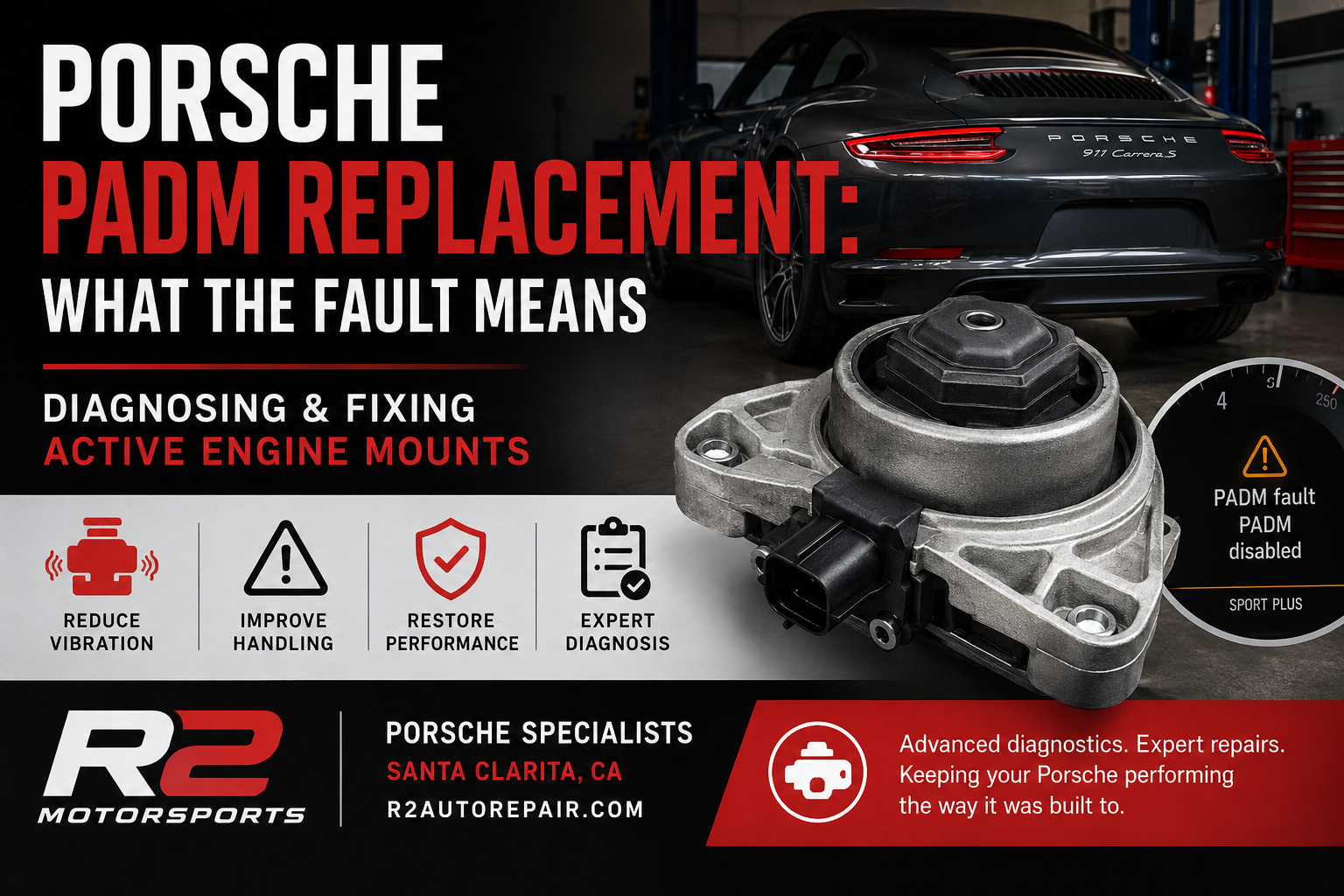

A Porsche should feel tight, balanced, and connected. So when a message like PADM fault, PADM disabled, or PADM service required shows up on the dash, it can feel like something serious has happened deep inside the drivetrain. The good news is that this warning does not always mean your engine or transmission is failing. In many cases, it points to a problem with the active drivetrain mount system.
If you are searching for Porsche PADM replacement, you are probably trying to figure out whether the mount itself is bad, whether a sensor failed, or whether the car is safe to drive. This guide breaks it down in plain language.
At R2 Motorsports, we help Porsche owners throughout Castaic, Santa Clarita, Valencia, Stevenson Ranch, and the surrounding Los Angeles area diagnose warning lights before expensive parts are replaced unnecessarily. If you need Porsche engine mount repair Santa Clarita, the key is not guessing. The key is proper Porsche diagnostics, a physical inspection, and understanding how the PADM system actually works.
Quick Takeaways
- PADM stands for Porsche Active Drivetrain Mounts, an adaptive mount system used on many Sport Chrono equipped Porsche models.
- A PADM fault does not automatically mean the engine mount is physically broken.
- Common symptoms include a dashboard warning, extra vibration, reduced sharpness in Sport or Sport Plus mode, and stored fault codes.
- Sensor related failures are commonly discussed by Porsche owners and repair communities, but a real diagnosis is still required.
- Full Porsche PADM replacement may be needed when the mount leaks, collapses, tears, or fails electrically.
- Ignoring the warning can affect handling feel and may place added load on the remaining mount.
- R2 Motorsports offers Porsche diagnostics and repair support for drivers looking for Porsche engine mount repair Santa Clarita.
What Is Porsche PADM?
PADM stands for Porsche Active Drivetrain Mounts. Depending on the model, owners may casually call them active engine mounts, dynamic engine mounts, or active transmission mounts. The wording can vary because Porsche uses the system across different platforms and driveline layouts.
The simple version is this: the mounts help control how much the engine and transmission move under load.
A traditional rubber or hydraulic mount is passive. It absorbs vibration and supports the drivetrain, but it cannot actively change behavior. PADM is different. The system can adjust mount stiffness depending on how the car is being driven. During relaxed driving, the mounts can allow more isolation for comfort. During aggressive cornering, acceleration, braking, or Sport Plus driving, the system can firm up to reduce drivetrain movement.
That matters because a Porsche is sensitive to weight transfer. When the engine or gearbox shifts around under load, the car can feel less precise. The rear of the car may feel slightly delayed, unsettled, or less sharp during quick throttle changes. PADM helps the car feel more stable by controlling that movement.
Porsche describes PADM as a system that combines the benefits of hard and soft mounts. The goal is more precise handling during fast corners and load changes while keeping comfort on uneven roads. That is why the system is often tied to performance packages like Sport Chrono.
For owners, the important thing is understanding that PADM is not just a comfort feature. It affects the way the car feels. When it fails, the car may still run, but it may lose some of the tight, controlled feel that makes a Porsche feel like a Porsche.
If your warning message appeared suddenly, schedule a diagnostic visit through the R2 Motorsports Porsche service page:
https://r2autorepair.com/porsche-service
Reference: Porsche Newsroom explains that PADM reduces drivetrain movement and helps combine stable handling with ride comfort.
https://newsroom.porsche.com/en/press-kits/718-spyder-cayman-gt4/fahrwerk-und-regelsysteme.html
What Does a PADM Fault Mean?
A PADM fault means the car detected a problem in the active drivetrain mount system. That can involve the mount, the sensor, the wiring, the control circuit, or communication between modules. It does not automatically prove that the entire mount assembly is destroyed.
That distinction matters because many Porsche owners panic when they see the warning. A PADM alert sounds expensive, and sometimes it is. Active mounts are more complex than standard rubber mounts. They may include internal electronics, fluid control, and model specific hardware. A complete Porsche PADM replacement can be significantly more expensive than replacing a conventional engine mount.
Common PADM related warnings may include:
- PADM fault
- PADM disabled
- PADM service required
- Chassis or drivetrain related warnings
- Sport or Sport Plus behavior that feels different than normal
The car may still start, idle, and drive. Some owners notice almost no change during normal commuting. Others feel more vibration, a looser rear end, clunking over transitions, or reduced sharpness during spirited driving. The symptom level often depends on the model, which side failed, how the mount failed, and whether the issue is mechanical or electronic.
This is where proper testing matters. A stored code can point the technician in the right direction, but it should not be the only deciding factor. The shop should inspect the mount for leaks, torn rubber, collapsed structure, damaged wiring, connector issues, and signs of physical movement. The diagnostic scan should also identify whether the fault is left side, right side, intermittent, current, or communication related.
At R2 Motorsports, this is where we slow the process down. We do not like parts swapping on high performance European cars. A Porsche owner deserves to know whether the car needs a full active mount, a wiring repair, a sensor related solution, or further testing.
For broader diagnostic support, visit:
https://r2autorepair.com/engine-repair/
Symptoms of Porsche Active Engine Mount Failure
A PADM issue can show up in a few different ways. Some symptoms are obvious. Others are subtle and only become noticeable when you know how the car normally feels.
The most common symptom is the warning message itself. You may be driving normally, start the car after sitting, or switch into Sport Plus, and suddenly the PADM warning appears. This is often the first sign because the system is monitored electronically.
Another symptom is vibration. A Porsche with a mount issue may feel rougher at idle, especially when cold. You may feel more vibration through the seat, floor, or steering wheel. This can be confused with a misfire, worn transmission mount, exhaust contact, or drivetrain issue, which is why scanning and inspection are both needed.
A failed or disabled PADM system can also affect the car’s feel during acceleration and cornering. The car may not feel dangerous, but it may feel less composed. You might notice extra drivetrain movement when getting on and off the throttle. During fast transitions, the rear of the car may feel less settled than usual.
Some owners also report clunks, knocks, or a heavy movement sensation when shifting from reverse to drive, accelerating from a stop, or driving over uneven roads. These symptoms are more concerning because they may point to a mount that is physically worn, leaking, or no longer controlling movement properly.
Here is the unique point many owners miss: not every vibration is a PADM mount, and not every PADM code creates vibration. A car can have an electronic PADM fault with very little physical symptom. A car can also have drivetrain movement from a worn passive component that feels like PADM but is unrelated.
That is why Porsche engine mount repair Santa Clarita should start with a complete check of the drivetrain support system, not just the warning light.
For European performance diagnostics, you can also review:
https://r2autorepair.com/european-auto-repair/
Why Porsche PADM Systems Fail
PADM systems live in a harsh environment. Engine heat, vibration, road shock, fluid movement, electrical load, and repeated performance driving all affect the mount over time. Unlike a simple rubber mount, an active drivetrain mount is both mechanical and electronic. That gives it more capability, but it also means there are more possible failure points.
A traditional mount usually fails in predictable ways. Rubber cracks. Fluid leaks. The mount collapses. The drivetrain starts moving too much. With PADM, the fault can also come from an electrical or sensor problem. That means the mount may look normal from the outside, but the car still logs a fault.
This is one reason online Porsche communities spend so much time discussing PADM sensor failures. Many owners report faults where the car drives normally, the mount does not show obvious physical damage, but the system still disables itself. Other cases are more mechanical, especially when there is visible leakage, torn rubber, or excess drivetrain movement.
Heat is another factor. Porsche engines and transmissions generate a lot of temperature, especially in traffic, canyon driving, and spirited weekend use. Santa Clarita Valley drivers also deal with hot weather, freeway commuting, and stop and go driving on the 5 freeway. Heat cycles can accelerate wear on rubber, seals, wiring, and connectors.
The system can also be affected by battery voltage and electrical health. Modern Porsche modules do not like weak voltage. A low battery, recent jump start, or charging issue can sometimes trigger multiple faults. That does not mean the warning should be ignored, but it does mean the technician should verify battery condition and electrical stability before condemning expensive parts.
The best approach is practical. Confirm the code. Inspect the mount. Check wiring and connectors. Verify battery health. Test the system. Then decide whether Porsche PADM replacement is truly necessary.
Reference: ImportCar describes Porsche Active Drivetrain Mounts as magnetorheological fluid filled mounts with chambers and an electromagnet.
https://www.import-car.com/porsche-active-motor-mounts/
Diagnosing a PADM Fault the Right Way
A correct PADM diagnosis should feel methodical. It should not be a quick scan followed by an automatic parts quote. These cars deserve better than that.
The first step is to document the customer complaint. When did the warning appear? Was the car cold or hot? Did it happen after a battery issue? Did it appear in Sport Plus? Was there a new vibration or only a dashboard message? These details help separate an electronic fault from a mechanical failure.
The second step is a Porsche capable diagnostic scan. Generic code readers may not show enough detail. A proper scan can identify mount specific faults, side specific faults, communication problems, and related system warnings. The technician should look for current faults, stored faults, and fault frequency.
The third step is physical inspection. This is where experience matters. The mounts should be checked for fluid leakage, rubber separation, impact damage, loose hardware, abnormal movement, and connector damage. If the mount is leaking or physically collapsed, sensor discussion becomes less important. The mount has a mechanical problem and likely needs replacement.
The fourth step is electrical verification. A damaged connector, corroded pin, rubbed wire, or voltage issue can create symptoms that look like a bad mount. A careful shop will check wiring integrity before ordering high cost components.
The fifth step is deciding between repair options. Some cars need a full Porsche PADM replacement. Some may need related electrical repair. Some may need further testing if the warning was triggered by voltage instability.
At R2 Motorsports, we also look at the owner’s driving style. A daily driven 911 used for commuting may have different priorities than a Cayman GTS used for track days or canyon drives. The right recommendation should match the car, the driver, and the condition of the system.
For maintenance related checks that help prevent bigger issues, see:
https://r2autorepair.com/factory-scheduled-maintenance/
Porsche PADM Replacement vs Sensor Related Repair
This is the decision point most owners care about. Do you replace the complete active mount, or is there another valid repair path?
The answer depends on what failed.
If the mount is leaking, torn, collapsed, or physically damaged, a full active mount replacement is usually the right path. No sensor repair will fix a mount that can no longer support or control drivetrain movement. In this case, replacing the complete mount protects drivability, handling, and long term reliability.
If the mount appears mechanically intact but has an internal electronic fault, the situation becomes more nuanced. Many Porsche owner discussions and newer repair resources focus on internal sensor failure as a common issue. Some aftermarket solutions target the sensor rather than the complete mount. That may be attractive because active mount assemblies can be expensive.
However, this is where the shop needs to be honest. Not every aftermarket sensor solution is equal. Not every car is a good candidate. Not every customer wants a non factory repair path. Warranty status, vehicle value, future resale plans, usage, and part availability all matter.
For some owners, genuine Porsche active mount replacement is the cleanest and most conservative solution. For others, especially out of warranty cars, a carefully evaluated sensor related repair may be worth discussing. The key is transparency.
At R2 Motorsports, we focus on giving Porsche owners the information needed to make a smart decision. If a mount is physically bad, we will say so. If the evidence points to an electrical or sensor issue, we will explain that too. The goal is not to sell the most expensive repair. The goal is to restore the car properly.
Reference: FCP Euro lists a genuine Porsche active engine mount kit at a high retail price, which reflects why diagnosis matters before replacing major assemblies.
https://www.fcpeuro.com/products/porsche-engine-mount-kit-genuine-porsche-991padmkt
Is It Safe to Drive With a PADM Fault?
Many Porsche owners ask whether they can keep driving after a PADM warning appears. The honest answer is: it depends on the symptoms.
If the car has only a warning message and feels normal, it may still be drivable for a short period. But it should still be inspected soon. The active mount system may be disabled, which means the car may not control drivetrain movement the way Porsche intended. That can affect handling feel, especially during aggressive driving.
If the car has clunking, heavy vibration, a harsh drivetrain movement, fluid leakage, or a major change in handling, do not treat it casually. Those symptoms suggest the mount may be physically compromised. Continuing to drive can place extra stress on surrounding components.
You should also be cautious with Sport Plus driving, track use, launch control, canyon driving, or hard acceleration until the system is checked. PADM exists because drivetrain movement matters under load. If the system is not working correctly, the car may still move under its own power, but it may not behave with the same precision.
There is another practical concern. When one mount is weak or disabled, the other mount may carry more load. That can accelerate wear. Waiting too long can turn one repair into a larger repair.
If you are local to Castaic or Santa Clarita and searching for Porsche engine mount repair Santa Clarita, schedule a proper inspection rather than clearing the warning and hoping it stays away.
For appointments, visit:
https://r2autorepair.com/contact-us/
Why Porsche Owners Choose an Independent Specialist
A PADM fault is not the type of issue most general repair shops are prepared to handle. The system is Porsche specific, electronically controlled, and tied to the way the car drives. A basic scan may not be enough.
An independent Porsche specialist gives you a middle ground between dealership level understanding and more personal service. The right shop can explain the fault, inspect the car, discuss options, and help you avoid unnecessary replacement when testing does not support it.
At R2 Motorsports, Porsche service is part of our European performance repair focus. We work with Porsche models that require careful diagnostics, not guesswork. That includes drivetrain concerns, PDK service, engine repair, electrical diagnostics, and performance related inspections.
For a PADM fault, the benefit is simple. You get a shop that understands why the warning matters and why the repair decision should not be rushed. A Porsche is not just another car with a mount. It is a chassis that depends on balance, control, and feedback. Engine and drivetrain movement affect the whole driving experience.
Local driving conditions also matter. Santa Clarita area drivers see heat, freeway mileage, steep grades, and stop and go traffic. Those conditions can expose weak mounts, aging electronics, and deferred maintenance. A proper repair should account for how the car is actually used, not just what the scan tool says.
If your Porsche also has shifting concerns, review our related PDK guide:
https://r2autorepair.com/porsche-pdk-service-repair-signs/
When to Schedule Porsche PADM Service
You should schedule PADM service as soon as the warning appears, especially if it returns after being cleared. A one time message after a weak battery should still be documented, but a repeated fault needs attention.
Schedule service quickly if you notice any of the following:
- PADM disabled message
- PADM service required warning
- New vibration at idle
- Clunking during throttle changes
- Loose feeling rear end
- Reduced sharpness in Sport or Sport Plus
- Fluid visible around the mount area
- Fault returning after clearing
The earlier the issue is checked, the better your options usually are. If the problem is wiring or voltage related, early diagnosis may save you from replacing parts unnecessarily. If the mount is physically failing, early replacement can protect surrounding components.
This is especially important for owners who drive enthusiast models like the 911, Cayman, Boxster, GTS, GT4, or other Sport Chrono equipped cars. These cars are built to communicate with the driver. When the mount system is not working correctly, the car can lose part of that precise feel.
The best advice is simple. Do not ignore the warning, and do not assume the worst. Get the car diagnosed by someone who understands Porsche systems.
Conclusion
A PADM fault can be frustrating, but it does not have to be confusing. Porsche PADM replacement may be the correct repair when the active mount is leaking, damaged, collapsed, or electrically failed beyond repair. But the warning itself is only the beginning of the story. The real answer comes from proper diagnostics.
PADM exists to help your Porsche balance comfort and performance. When the system works, it reduces drivetrain movement and helps the car feel sharper during fast corners, braking, and throttle changes. When it fails, you may notice a warning light, vibration, clunking, or a less precise driving feel.
For Porsche owners in Castaic, Santa Clarita, Valencia, Stevenson Ranch, and nearby Los Angeles communities, R2 Motorsports provides the kind of Porsche focused inspection this issue deserves. We check the codes, inspect the mounts, verify wiring, consider battery health, and explain the repair options clearly.
If your Porsche is showing a PADM warning, do not keep guessing and do not let someone replace expensive parts without a real diagnosis. Schedule an inspection with R2 Motorsports and get a clear answer before the problem becomes more costly.
Book Porsche service here:
https://r2autorepair.com/porsche-service/
FAQs
What does the Porsche PADM fault mean?
A Porsche PADM fault means the active drivetrain mount system has detected a problem. It may involve the mount, sensor, wiring, voltage, or system communication. A proper diagnostic scan and inspection are needed before deciding on Porsche PADM replacement.
Can I drive with a PADM disabled warning?
You may be able to drive carefully if the car feels normal, but you should avoid aggressive driving until it is inspected. If there is clunking, vibration, leaking, or a major handling change, schedule Porsche engine mount repair Santa Clarita as soon as possible.
Does PADM only come with Sport Chrono?
PADM is commonly associated with Sport Chrono equipped Porsche models, but availability can vary by model and year. A Porsche specialist can confirm whether your specific 911, Cayman, Boxster, or 718 has active drivetrain mounts.
Is a PADM fault always a bad engine mount?
No. A PADM warning does not always mean the mount is physically broken. Some faults may be sensor, wiring, voltage, or communication related. That is why R2 Motorsports recommends diagnosis before replacement.
How much does Porsche PADM replacement cost?
Cost depends on the model, side, parts availability, labor time, and whether one or both mounts need replacement. Active mount assemblies are more expensive than standard mounts, so accurate testing is important before approving repairs.
Reader Feedback
Have you seen a PADM warning on your Porsche, or did your car start feeling different in Sport Plus mode? Share your experience, save this guide, and send it to another Porsche owner who may be dealing with the same warning. What symptom showed up first on your car: the warning message, vibration, or a change in handling?