

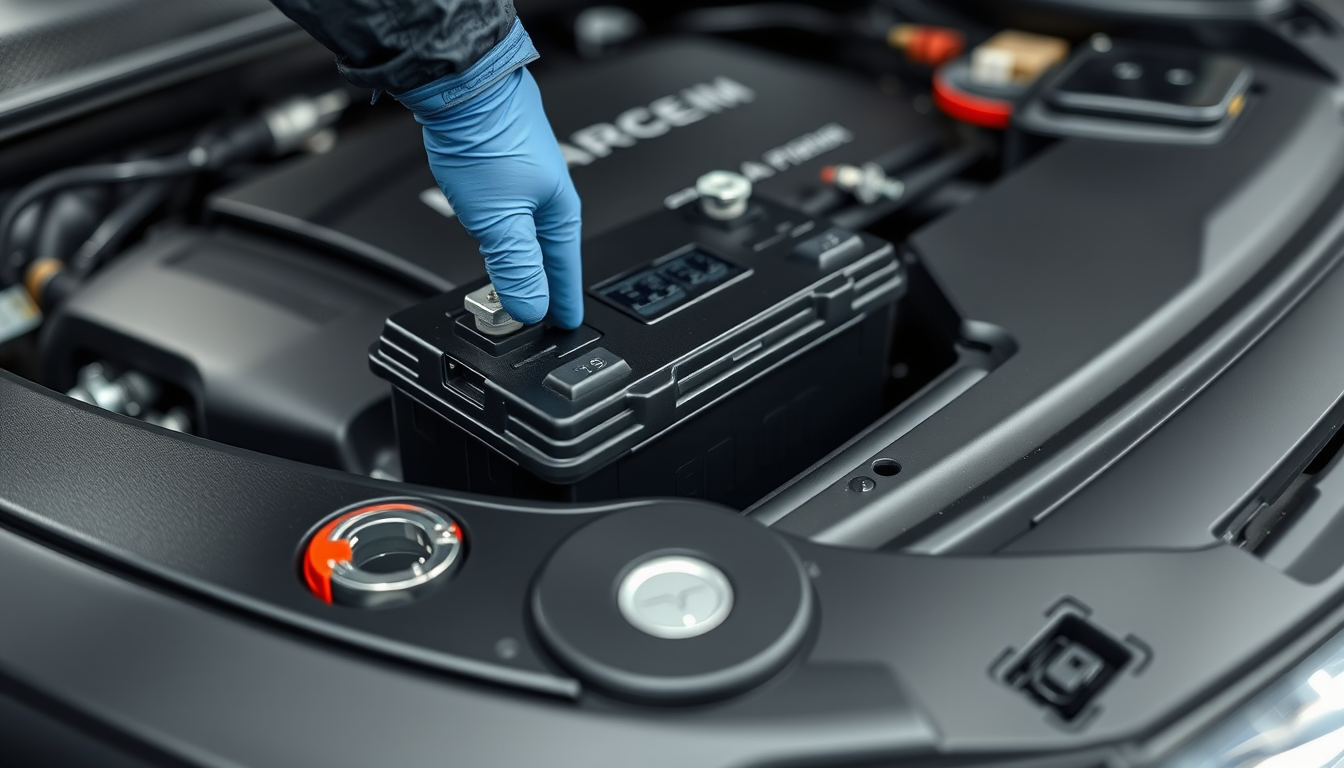
Your Mercedes just got a new battery. It cranks fine, the dash lights are happy, and you drive off thinking the job is done. It isn’t, not quite. Mercedes Battery Registration is the step that tells the charging system a fresh battery is actually installed. Skip it, and your car’s computer keeps running a charging strategy built for the battery you just threw away. On a modern Mercedes, that mismatch doesn’t just annoy you with a warning light. It can quietly shorten the life of the battery you paid for.
Key takeaways:
- Mercedes Battery Registration resets the charging profile stored in the front SAM control unit so the alternator stops charging like the old battery is still there.
- Skip it, and the system can overcharge or undercharge the new battery, degrading it well before its time.
- Mercedes battery replacement cost typically runs a few hundred dollars for a standard 12V unit, and registration is a separate line item, not an automatic part of the swap.
- S-Class and other models with an auxiliary battery may need two registrations, not one.
- This isn’t optional on a car with start-stop and an Intelligent Battery Sensor. It’s how the system is designed to work.
What Does Mercedes Battery Registration Actually Do?
Every modern Mercedes with start-stop and a Battery Management System monitors the battery constantly. It does this through an Intelligent Battery Sensor (IBS) clamped to the negative terminal. Bosch, the company behind the sensor design used across the industry, states the IBS tracks state of charge, state of function, and state of health in real time. It works across a voltage range of 5V to 18V and a current range of -1500A to 1500A, then reports that data over a LIN bus to the vehicle’s energy management system. Source
That data builds a picture of exactly how tired the old battery was. When you pull it out and drop in a new one, the car has no idea. Registration happens through the front SAM control unit, using a factory-level scan tool. It tells the system the battery’s age counter should reset to zero and its charge profile should start fresh. Why does that matter so much on these cars specifically? Because the alternator isn’t just spinning at a fixed voltage anymore. It’s following instructions from a computer that’s still convinced your battery is three years old and needs a gentler, more conservative charge.
Why Can Skipping It Shorten a New Battery’s Life?
Here’s the part owners don’t expect: the danger runs both directions. According to Midtronics, a battery diagnostic equipment manufacturer, an unregistered battery can end up undercharged. When that happens, “sulfation can occur that degrades the plates inside the battery.” Source Or it can end up overcharged, which cooks a modern AGM battery from the inside just as fast. Either way, you paid for a new battery and gave it the charging habits of a worn-out one.
Midtronics also notes that start-stop functionality can fail to re-engage if the Battery Management System isn’t told a healthy battery is on board. That means more idling at stoplights and more fuel burned over a year of driving. Source The same source lists Mercedes-Benz alongside BMW, Audi, Volkswagen, Porsche, and Volvo as brands where this registration step is required, not optional. That’s most of the European makes that come through our shop. It notes the requirement is spreading to more manufacturers as intelligent energy management becomes standard equipment. Source
We see the pattern on the lift regularly with Mercedes models that came in for something unrelated. Maybe it’s an odd electrical glitch, or a battery that died again after only a year. Trace it back far enough and there’s a battery swap in the history with no registration on record.
Mercedes Battery Replacement Cost: What You’re Actually Paying For
So what does this actually run you? RepairPal’s cost estimator for a Mercedes-Benz E350 puts total battery replacement between $284 and $411. That splits out to roughly $69 to $102 in labor and $215 to $309 in parts. Source That’s a reasonable baseline for mercedes battery replacement cost on a mainstream sedan. Your number will move with model, battery type, and where the battery lives on your particular platform.
A separate cost breakdown from The Pricer notes that OEM Mercedes AGM units alone can run $400 to $700. Computer registration or coding steps on late-model Mercedes typically add another $25 to $80 to the invoice as a distinct line item, on top of the battery itself. Source The same source pegs a combined main-plus-auxiliary battery job, common on larger sedans, at $600 to $1,000 or more. Source If a quote you’re comparing doesn’t list registration anywhere, ask directly whether it’s included. It should be.
Which Mercedes Models Need Battery Registration?
How do you know if your Mercedes qualifies? If it has start-stop, it needs battery registration. That covers the vast majority of C-Class, E-Class, GLE, GLC, and S-Class models built over roughly the last decade and a half. The wrinkle is the S-Class and a handful of other larger platforms. These run a second, smaller auxiliary battery to keep low-draw electronics powered without waking the main battery. Replace either one on those cars and it needs its own registration. Miss the auxiliary battery step because everyone was focused on the big one under the hood, and you’ve solved half the problem while leaving the other half ticking.
This is exactly why a factory-correct scheduled maintenance visit matters more on these platforms than on a simpler car. A battery swap here isn’t a parts-counter job. It’s a procedure with a diagnostic step baked in.
The battery itself matters too. Mercedes vehicles with start-stop use AGM (Absorbed Glass Mat) batteries, not the flooded lead-acid type in an older car. The charging system is calibrated around AGM behavior, so dropping in a cheaper flooded battery to save money undermines the whole point of registering it correctly in the first place. Get the chemistry right, get the registration right, and the system does what it was designed to do.
How Does Mercedes Battery Registration Actually Get Done?
Registration requires a scan tool that can talk to the front SAM control unit and write the new battery’s data, capacity and chemistry, into the module. A basic code reader that clears check-engine lights won’t touch it. Neither will a battery tester, no matter how good it is at telling you the old battery was junk. This is squarely diagnostic territory. It’s where proper factory-level diagnostics earn their keep instead of just guessing at a part and hoping.
Is it a long job? Not really. The registration itself typically takes only a few minutes once the tool is connected. The value isn’t in the time it takes. It’s in having the right equipment and the SAM module knowledge to do it correctly the first time, on a car where a wrong entry can trigger dash warnings that have nothing obviously to do with the battery.
What Are the Signs the Registration Step Got Missed?
A few patterns show up when this step was skipped on a previous battery swap. So what should you actually watch for?
- A battery that seems to drain faster than it should, especially overnight
- Start-stop that used to work and now doesn’t kick in at idle
- A battery warning light that pops up despite a battery that’s objectively new
None of these prove registration was missed. But on a car with a recent battery swap in its history, they’re the first thing worth ruling out before anyone reaches for more expensive diagnoses.
Getting It Right the First Time
If you’re due for a battery on your Mercedes, or if you already had one installed somewhere that didn’t mention registration at all, that’s worth a call. R2 Motorsports handles Mercedes battery replacement and registration with the correct factory-level tools, on both main and auxiliary batteries. The charging system knows exactly what it’s working with from day one. If that sounds like your car, give us a call at 661-251-3278.
Frequently Asked Questions
Do all Mercedes-Benz models need battery registration?
Any Mercedes with a start-stop system and a Battery Management System needs it. That’s most models built in roughly the last decade and a half. Older Mercedes without start-stop generally don’t require the step.
Can I register a new battery myself at home?
Some owners with the right aftermarket diagnostic tool and vehicle-specific software can do it. But it requires a scan tool capable of writing to the front SAM control unit, not a basic reader. For most owners, it’s simpler and safer to have it done alongside the battery swap by whoever installs it.
What happens if I never register the new battery?
The charging system keeps applying the profile it built for the old battery. That can mean undercharging, which leads to sulfation, or overcharging, both of which shorten the new battery’s usable life. You may also notice start-stop failing to engage.
Does the auxiliary battery on my S-Class need its own registration?
Yes. The auxiliary battery runs on its own registration separate from the main battery. Replacing one doesn’t cover the other.
Is battery registration included in the price when I buy a battery at a parts store?
Not automatically. Registration is a separate diagnostic step that requires the right scan tool, so it’s worth confirming with whoever sells or installs the battery whether it’s included or billed separately.