

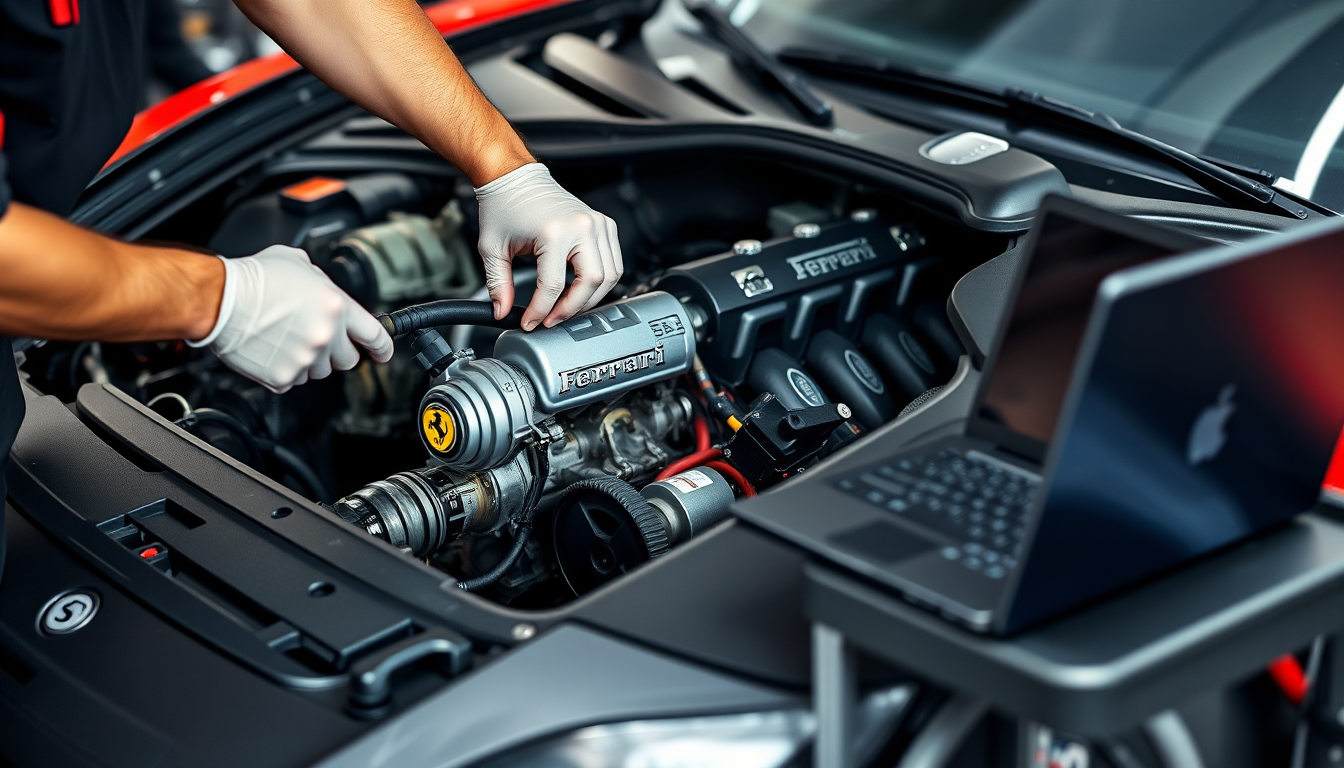
Ferrari throttle body calibration is the step that gets skipped most often, and it’s usually the reason a Ferrari comes back from a battery job or throttle body service with a rough, hunting idle. The engine isn’t broken. It just hasn’t been told where “closed” is yet. Every Ferrari built with an electronically controlled throttle relies on the ECU to relearn each throttle plate’s rest position before idle settles back into the smooth note these cars are known for. Technicians and Ferrari owners often call this recalibration the Ferrari self-learn test, since the ECU is literally relearning its own baseline. Skip that step, and the engine stumbles on cold start, hunts at a stoplight in Valencia traffic, or stalls at the worst possible moment.
Key Takeaways
- Ferrari throttle body calibration lets the ECU relearn each throttle plate’s closed position after a battery disconnect, throttle body cleaning, or ECU work. Skipping it is a common cause of rough idle that shows up right after service.
- Electronic throttle control systems store learned rest positions in the control module, and disconnecting power erases them, according to longtime automotive technical writer Larry Carley (AA1Car).
- On the Ferrari 360, the two Bosch throttle bodies (one per cylinder bank) have to resynchronize through a documented idle-and-drive relearn cycle (Aldous Voice).
- A rough idle that appears right after service and improves over a normal drive is a calibration issue. One that lingers or gets worse points to a real mechanical or sensor problem worth a full diagnostic.
What Does Ferrari Throttle Body Calibration Actually Do?
Ferrari throttle body calibration teaches the engine control unit exactly where each throttle plate sits at rest. Ferrari has used electronic, drive-by-wire throttle control rather than a physical cable for decades. There’s no mechanical linkage forcing the plate to a known position anymore. The ECU has to learn it, store it, and cross-check it every time the system loses power.
“A special relearn procedure is required when parts have been replaced or the throttle control wiring harness has been disconnected. The relearn procedure is necessary so the control module can learn the rest positions of the gas pedal and throttle,” writes longtime automotive technical author Larry Carley (AA1Car). That’s true across nearly every drive-by-wire vehicle on the road. On a Ferrari V8 or V12, though, the margin for error is thinner. Get the relearn wrong, and the owner feels it every time they roll up to a light.
Ferrari’s V8 platform compounds the problem, because the ECU isn’t calibrating one throttle plate. It’s calibrating two. Why two? As one detailed technical write-up on 360 throttle body service puts it, “The Ferrari 360 has two TB’s. One for each bank of four cylinders” (Ferrari 360 Owners Resource). Two throttle bodies means two learned positions that have to agree with each other. If one bank settles slightly rich or slightly lean relative to the other, the idle doesn’t just sit low or high. It hunts, because the ECU is constantly correcting a mismatch between banks.
Why Does a Battery Disconnect or Throttle Body Service Trigger a Rough Idle?
A battery disconnect, even a short one, wipes the adaptive values the ECU built up over weeks of driving. That forces the whole throttle control system back to factory defaults until it relearns them. That’s the direct answer. The less obvious part is how many routine jobs trigger it without anyone intending to. A dead battery after a Ferrari sits through a slow SCV winter. A new battery install. An ECU or module swap. Simply pulling the throttle bodies to clean carbon off the plates.
Right after any of those jobs, don’t panic if the idle sounds off. Is the car actually broken, or is it just mid-relearn? Documentation of a Ferrari 360 reset describes exactly this stage: “the engine will sound terrible, as if it’s misfiring” because “all the trim values have been erased from the ECUs” (Aldous Voice). That rough patch is expected. It’s the ECU working from a blank slate, not a mechanical fault. The fix isn’t more parts. It’s giving the car the specific idle and drive cycle it needs to log new, correct trim values.
What Is the Ferrari Self-Learn Test, and How Does It Work?
Ferrari owners and technicians both use the term “self-learn” for this process. It’s specific enough that it shows up as its own topic on Ferrari forums, including a thread dedicated to the 550’s self-learn behavior after a battery disconnection (FerrariChat). The Ferrari self-learn test isn’t a single button press. It’s a structured sequence: restore power, let the fly-by-wire system run its own internal check, then feed the ECU a clean, controlled range of idle and driving conditions so it can log accurate values instead of guessing.
The 360’s documented procedure shows the shape of it. After power is restored, the technician turns the key to position II and waits for the “Check OK” message to display. Then comes another wait, roughly ten seconds, “to allow the fly by wire throttle system to go through a self learning procedure.” From there the engine idles for several minutes before a specific low-load drive sequence. No hard acceleration. No erratic shifting (Aldous Voice). Later V8 and V12 Ferraris don’t necessarily use that exact sequence of steps or timing. But the underlying logic carries through the whole electronic-throttle lineup. Let the ECU log a stable baseline before anyone demands anything from it. Rush that step, drive hard five minutes after a battery reconnect, and the car never gets a clean baseline to work from.
When It’s the Calibration, and When It’s Something Else
So how do you actually tell a car that just needs to relearn from one that’s telling you something’s genuinely wrong? Timing and trend are the tells. A calibration issue shows up immediately after service and gets better, sometimes noticeably better within a single drive, as the self-learn cycle completes. A real problem shows up the same way but doesn’t improve, or it gets worse. Think a vacuum leak, carbon-fouled throttle plates, a throttle position sensor drifting out of range, or an idle air path that’s partially blocked.
That distinction matters because throwing another relearn cycle at a genuine mechanical fault just wastes time. If the idle is still hunting after a proper self-learn procedure and a normal drive cycle, it’s worth a full auto diagnostics session rather than another reset attempt. On a car with this much electronic integration between the throttle, the ECU, and the fuel and ignition strategy, guessing at parts gets expensive fast.
Why This Belongs With a Ferrari Specialist
Every Ferrari on the road today, from the 360 and 550 through the F430, 458, California, 599, and 612, runs some version of this electronically controlled throttle architecture. Why does that matter to the owner instead of just the technician? Because the self-learn logic is specific to how Ferrari built the system, and it’s easy to get impatient with it if you don’t work on these cars every day. That’s really the whole case for exotic auto repair and the engine repair that goes with it. It should be done by a shop that already knows what a normal relearn looks like versus a genuine fault.
If your Ferrari has been idling rough since a battery disconnect, a new battery, a throttle body cleaning, or any electrical work, and it hasn’t smoothed out over a normal drive, that’s worth a look. Give R2 Motorsports a call at 661-251-3278 and we’ll sort out whether it’s a calibration that never finished or something the throttle bodies are actually trying to tell you.
Frequently Asked Questions
What causes a rough idle right after a Ferrari battery disconnect?
Disconnecting the battery clears the ECU’s learned throttle position values, so the engine runs on factory defaults until the self-learn procedure rebuilds them. Documentation of the process on a Ferrari 360 notes the engine can sound “terrible, as if it’s misfiring” immediately afterward, which is expected at that stage, not a sign of damage (Aldous Voice).
Can I do the Ferrari self-learn test myself at home?
The basic idea, restoring power, letting the system complete its own check, then idling and driving gently, is documented for owners of some models. But the exact steps, wait times, and drive sequence vary by platform and model year, and getting them wrong can leave the ECU with an incomplete or mismatched baseline between throttle bodies. A shop with auto diagnostics equipment built for these platforms can confirm the relearn actually completed instead of guessing from how the idle sounds.
Does every Ferrari model use the same throttle body calibration procedure?
No. The underlying logic, electronically controlled throttle plates that need a learned rest position, runs through the whole modern Ferrari lineup, but the specific sequence differs by model and engine management system. The 360’s documented procedure, for example, includes a defined idle period followed by a specific low-RPM drive sequence (Aldous Voice). Later V8 and V12 models built on different Bosch Motronic generations don’t necessarily follow the same steps.
Why does a Ferrari V8 have two throttle bodies instead of one?
Ferrari’s V8 engines use one throttle body per cylinder bank rather than a single shared unit. On the 360, that means “two TB’s, one for each bank of four cylinders” (Ferrari 360 Owners Resource). Because there are two, they have to be calibrated to agree with each other. A mismatch between banks is a common reason idle hunts rather than just running slightly high or low.
How do I know if my Ferrari needs more than just a throttle body relearn?
If the idle is still rough or hunting after a completed self-learn cycle and a normal drive, the issue likely isn’t calibration anymore. Carbon buildup on the throttle plates, a drifting throttle position sensor, or a vacuum leak can all mimic a relearn problem but won’t resolve with another reset. At that point a full diagnostic workup is the faster path to an actual answer.