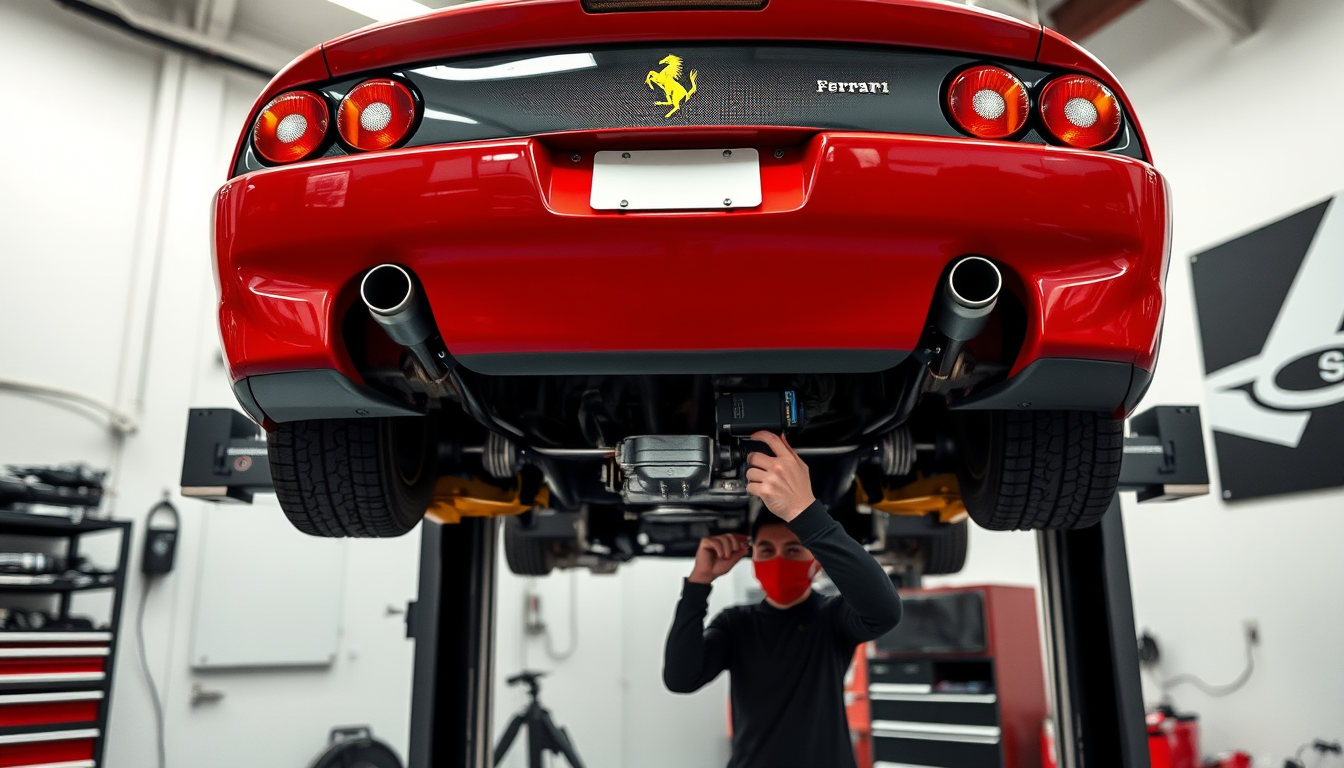

Ferrari F1 gearbox problems almost always start in the same place: the clutch and the hydraulic system that drives it. When shifts go slow, the car clunks into first, or takeoff gets jerky, owners assume the gearbox itself is failing. It usually isn’t. The F1 system Ferrari debuted on the F355 in 1997 was the first paddle-shift setup on a production road car (Ferrari), and it’s really a normal manual gearbox with a robot working the clutch. Understand that, and the symptoms start to make sense.
Key Takeaways
- The F1 system is a conventional 6-speed manual with the clutch pedal replaced by an electrohydraulic actuator, so most “gearbox” faults are really clutch or hydraulic faults (CarBuzz).
- A Ferrari 355 F1 clutch life varies between roughly 15,000 and 30,000 miles depending on how it’s driven and set up (Magneto).
- Slow or harsh shifts often trace to a tired accumulator or pump, not the clutch disc itself. A healthy system shouldn’t cycle the pump more than about once a minute at rest (Craig Waterman).
- A factory manual 355 commands higher prices than the F1 car, but a converted car is not a factory manual (Magneto).
What is the Ferrari F1 gearbox, exactly?
The Ferrari F1 gearbox is a conventional manual transmission with the clutch pedal removed and an electrohydraulic system doing the clutch and shift work for you. On the F355 it’s the same 6-speed gearbox as the gated manual, just with the clutch operated by a high-pressure hydraulic setup instead of your left foot (CarBuzz).
Ferrari put it on the road first. The 1997 F355 Berlinetta was the first-ever production car to carry the paddle-shift system, derived from the technology Ferrari ran in Formula 1 starting in 1989 (Ferrari). The F355 itself ran from 1994 to 1999 with a 3,495cc V8 making 375 horsepower at 8,250 rpm, and a little over 11,000 were built (Wikipedia).
Here’s the part that trips people up. This is not a modern dual-clutch transmission. It’s a single-clutch automated manual, so it pauses to swap gears the same way you would with a clutch pedal. By modern standards the shifts are slow, and Ferrari’s early promise that you could keep your foot flat through a change instead rewarded drivers with a hard jerk forward (CarBuzz). That behavior is the system working as designed, not a fault. Knowing the difference is most of the battle when you’re chasing transmission repair on one of these cars.
What causes slow or clunky F1 shifts?
Slow and clunky F1 shifts usually come from the hydraulic side: a weak accumulator, a struggling pump, or worn actuator seals, not the gearbox gears themselves. The accumulator stores hydraulic pressure so the system can shift instantly. When it weakens, the pump can’t keep up, and shift quality falls apart, especially once the car is hot (Craig Waterman).
| What you feel | Most likely cause | Why it matters |
|---|---|---|
| Slow or harsh shifts, worse when hot | Weak accumulator or tired pump | A clutch job won’t fix it, and the symptom returns |
| Grabby, creeping, or delayed takeoff | Low hydraulic pressure mimicking clutch wear | Easy to misdiagnose as a worn clutch |
| Clunk into first, lurch off the line | Worn clutch disc or drifted bite point | Confirm with a clutch wear reading first |
| Pump cycling every few seconds at rest | Accumulator losing its nitrogen charge | Healthy systems cycle roughly once a minute |
| Stuck in one gear, erratic shift logic | Gearbox ECU, sensor, or actuator fault | Needs a diagnostic scan, not parts |
From our bay: the F1 cars that cost owners the most are almost never the ones with a single dead part. They’re the cars where a tired accumulator got treated as a worn clutch, so a fresh clutch went in, the shifts still felt wrong, and the real problem was still sitting there. Read the system first. The parts come second.
The accumulator is the part most owners never think about. Inside is a rubber bladder holding a nitrogen charge against the hydraulic fluid. Over years that bladder loses its charge or ruptures, letting nitrogen into the circuit. The clearest tell is pump behavior at idle: a healthy system shouldn’t cycle the pump more than about once every 60 seconds when you’re not shifting, while a failing one cycles every few seconds (Craig Waterman). Ever notice the pump kicking on constantly while the car just sits? That’s your answer.
A weak accumulator doesn’t just slow the shifts. It also makes clutch control erratic, so you get creep, a grabby takeoff, or delayed engagement that feels exactly like a worn clutch (Craig Waterman). This is why guessing is so expensive on these cars. The other usual suspects are the electrohydraulic pump itself, the actuator that can leak internally, and the gearbox ECU, which can throw the shift logic off with a software or sensor fault (Italian Design and Racing). Sorting which one it is starts with real auto diagnostics, not a parts swap.
How long does a Ferrari 355 F1 clutch last?
A Ferrari 355 F1 clutch typically lasts between 15,000 and 30,000 miles, and the spread is huge because wear is driven almost entirely by how the car is driven and set up (Magneto). Two identical 355s can be 15,000 miles apart on clutch life purely from habits and software setup.
The single-plate clutch is the same part the manual car uses, so it responds to the same abuse. Lots of city miles wear it faster. The fixes are simple and free: don’t ride the bite point creeping forward in traffic, don’t sit in gear at a light, and let the system warm before you drive it hard. Magneto’s F355 guide specifically calls out cold double-declutching and avoiding gear selection at stops as ways to extend clutch life (Magneto).
What does this mean if you’re buying or worried about yours? The odometer tells you very little. A clutch wear reading taken on a Ferrari diagnostic computer tells you almost everything, and a car with a documented reading and a setup that’s been adjusted properly is worth far more than one with a mystery shift feel. We read clutch wear before anyone signs anything, the same way we’d start any serious exotic auto repair on the platform.
Why does my F1 Ferrari clunk into first or hesitate?
A clunk into first or a hesitation off the line points at clutch engagement, which on an F1 car means the clutch disc, the actuator, or the hydraulic pressure feeding it. The system has to find the clutch bite point precisely every time. When the disc is worn or the pressure is low, that bite point drifts, and you feel it as a clunk, a delay, or a lurch (Italian Design and Racing).
The known F1 failure list backs this up: clutch slippage, delayed or abrupt gear shifts, difficulty engaging a gear, and in bad cases getting stuck in one gear entirely (Italian Design and Racing). The trap is assuming every one of those means a fresh clutch. Remember that a tired accumulator mimics a worn clutch closely (Craig Waterman). Replace the clutch on a car whose real problem is hydraulic, and you’ve spent a lot of money to fix nothing.
The correct order is to read the clutch wear, check pump and accumulator behavior, then confirm the actuator and software before condemning the friction disc. That sequence is the whole job. Do it backward and the bill doubles.
Should you convert a Ferrari F1 car to a manual?
Converting an F1 car to a gated manual is a real option, and several specialists offer it, but it’s a personal and financial decision rather than a repair. A factory manual 355 is already the more sought-after car and commands higher prices than the F1 version (Magneto). That gap is exactly why conversions exist.
The honest catch is that a converted car is not a factory manual, and the market knows the difference. You’re spending real money to change the character of the car, not to make it worth what a born-gated example is worth. For a driver who plans to keep the car and wants the gated-shift experience, that can be money well spent. For someone chasing resale value, the math rarely works out the way it looks on paper. The conversion itself is genuine engineering work, swapping in the clutch pedal, the gated gate, and the linkage, and it’s offered as a deliberate product by F1-transmission shops (Italian Design and Racing).
So which is right for you? If your F1 system is healthy and you enjoy it, keep it and maintain it. If it’s tired, you dislike the slow shifts, and you intend to own the car for years, a manual swap is worth pricing out. Just don’t do it expecting a worn-out F1 system to be your cheapest path back on the road. The video below walks through that exact decision on a 355 that came through our bay.
Watch this Should This Ferrari 355 Get a Manual Swap? job on our Instagram (@r2__motorsports)
When to call a specialist about your F1 Ferrari
If your car shows any of the classic F1 symptoms, slow or jerky shifts, a clunk into first, a grabby takeoff, or a pump that cycles constantly at rest, that’s the time to have someone read it properly before throwing parts at it. The difference between a $200 diagnosis and a wasted clutch job is knowing whether the fault is mechanical or hydraulic. These are not generic cars, and an F1 system rewards the shop that knows to check the accumulator and pump before the clutch.
If those symptoms match your car, call R2 Motorsports at 661-251-3278 and we’ll tell you straight what we find. We treat the F1 system as the precision European auto repair it is, and a proper clutch and hydraulic service belongs in your factory scheduled maintenance plan, not the someday pile.
Frequently Asked Questions
Is the Ferrari F1 gearbox reliable?
It can be, when it’s maintained correctly. The F1 unit is a conventional 6-speed manual with an electrohydraulic clutch actuator (CarBuzz). The gearbox itself is durable. The wear and trouble live in the clutch, pump, and accumulator, all of which are serviceable when caught early.
How much does a Ferrari 355 F1 clutch last?
A 355 F1 clutch typically lasts between 15,000 and 30,000 miles, with use being the deciding factor (Magneto). City driving and riding the bite point shorten it. A documented clutch wear reading tells you far more about remaining life than the odometer does.
Why are my F1 shifts slow or jerky?
Slow or jerky shifts usually trace to a weak accumulator or struggling pump, not the gears. A healthy system shouldn’t cycle the pump more than about once a minute at rest, while a failing one cycles every few seconds (Craig Waterman). Some clunkiness at low speed is also normal for this single-clutch design.
Was the Ferrari 355 the first paddle-shift car?
Yes. The 1997 Ferrari F355 Berlinetta was the first production road car with a Formula 1-style paddle-shift gearbox, derived from technology Ferrari ran in F1 starting in 1989 (Ferrari). It used the same 6-speed gearbox as the manual car.
Is a manual conversion worth it on an F1 Ferrari?
It depends on your goals. A factory manual 355 commands higher prices than the F1 car, which is why conversions exist (Magneto). But a converted car is not a factory manual. It’s worth it for a long-term owner who wants the gated feel, less so for resale alone.
Sources
- Ferrari, “Great Ferrari Innovations: The F1 semi-automatic gearbox,” retrieved 2026-06-01, https://www.ferrari.com/en-EN/magazine/articles/great-ferrari-innovations-the-f1-semi-automatic-gearbox
- Wikipedia, “Ferrari F355,” retrieved 2026-06-01, https://en.wikipedia.org/wiki/Ferrari_F355
- CarBuzz, “This 1990s Ferrari Was The First Car To Have A Flappy Paddle Gearbox,” retrieved 2026-06-01, https://carbuzz.com/ferrari-355-first-car-flappy-paddle-gearbox/
- Magneto, “1994-1999 Ferrari F355 buying guide,” retrieved 2026-06-01, https://www.magnetomagazine.com/articles/ferrari-f355-buying-guide-by-magneto/
- Craig Waterman, “Ferrari, Lamborghini and Maserati F1 Accumulator Failure Guide,” retrieved 2026-06-01, https://craig-waterman.com/?p=584
- Italian Design and Racing, “Potential Issues with the Ferrari F1 Transmission,” retrieved 2026-06-01, https://italiandesignandracing.com/News/219/potential-issues-with-the-ferrari-f1-transmission