
Exotic Car Diagnostics on a Ferrari, a Lamborghini, or a modern Porsche isn’t the same job as pulling a code on a family sedan. Plug a fifty dollar generic reader into a 992 Turbo S and you’ll get one flashing check engine light. Maybe a single powertrain code. Meanwhile the car quietly stores faults across a dozen other modules you’ll never see.
That’s the gap between a code reader and a factory tool. A problem that looks simple on the surface can take a specialist to actually solve. This article breaks down what a factory level scan tool finds that a generic scanner can’t, and why expert diagnostics for exotic cars almost always starts with the manufacturer’s own software.
Key Takeaways
- A generic OBD-II reader only accesses the one module every U.S. car has been required to expose since 1996: the powertrain computer that watches emissions (California Air Resources Board).
- A modern luxury car can carry well over 100 networked control modules; the BMW 7-series alone can carry 150 or more (IEEE Spectrum).
- Independent shops can legally use much of the same factory software as the dealer, thanks to the SAE J2534 pass-thru standard and right to repair agreements.
- Security-sensitive modules, like immobilizers and gateway computers, are locked behind a credentialed access system that only vetted shops can use.
Why Exotic Car Diagnostics Need More Than a Generic Code Reader
A generic scanner reads exactly one module: the powertrain computer that the federal government requires every gasoline car sold in the U.S. to expose since 1996. California’s OBD-II mandate requires that system to monitor “virtually every component that can affect emission performance” (California Air Resources Board). That’s it. It was never designed to see the transmission control unit or the suspension computer. It can’t touch the twelve or more modules running an infotainment and driver assist suite, or anything a manufacturer considers proprietary.
Here’s the part owners don’t expect: a modern high end car isn’t running one computer, it’s running a small network of them. IEEE Spectrum reports that a Volvo XC90 carries roughly 110 ECUs, and a BMW 7-series with a full driver assist package can carry 150 or more (IEEE Spectrum).
A Ferrari, a Lamborghini, or an AMG car isn’t simpler. Every one of those modules can set its own fault codes on its own internal network segment. A tool that only speaks the generic OBD-II protocol never sees any of it. So when a shop’s diagnostic check only covers the powertrain, what’s actually being missed?
What a Factory Level Scan Tool Actually Sees
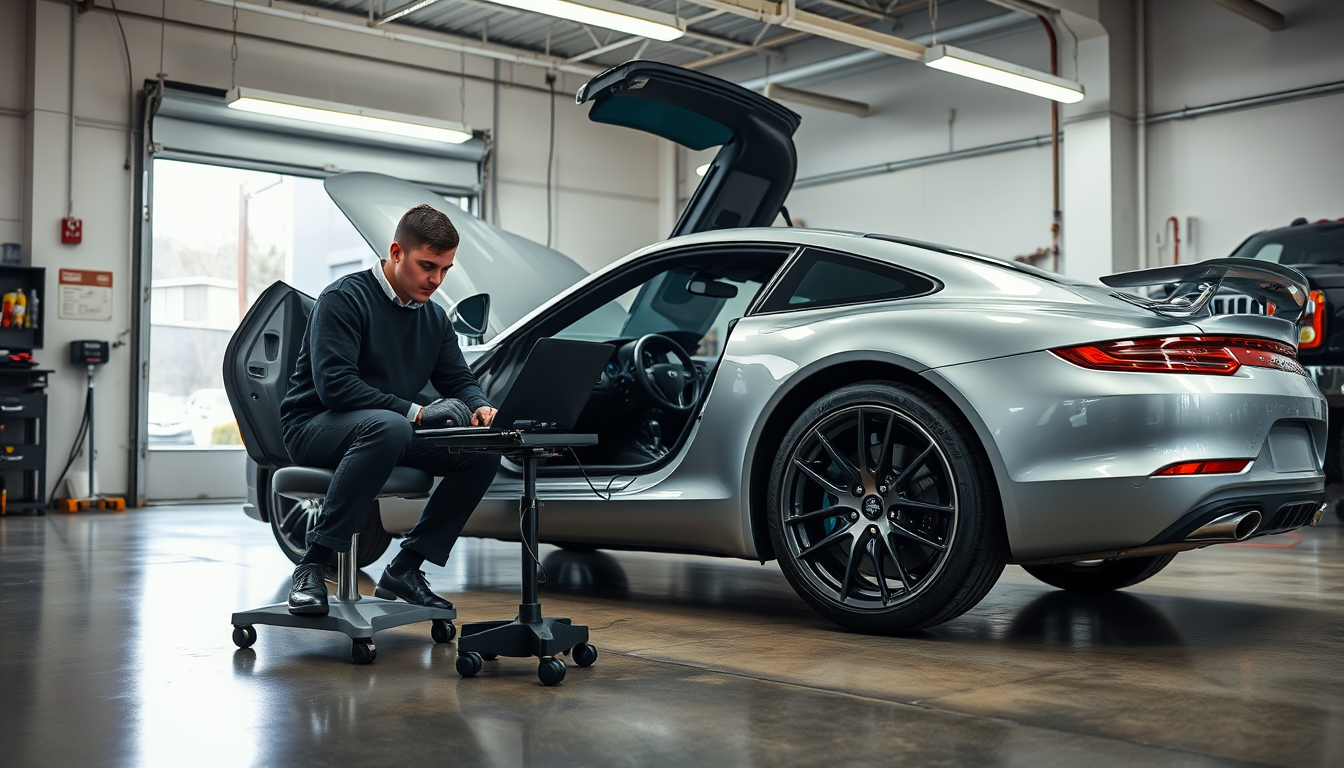
A factory tool talks to every module on the car, not just the one the EPA mandates. On a 991 or 992 Porsche that means PASM ride height and damper data, PDK clutch adaptation values, and stability control status, all in one session. On a modern Mercedes it means access to the SCN coding tables that tell each module which options and calibrations the car actually has. Generic scanners were never built for that conversation.
This matters because a lot of exotic platforms hide their real complaint behind a module a generic tool can’t reach. A rough downshift on a dual clutch gearbox. A suspension that sits low on one corner. A stability light that flickers under braking. None of that lives in the emissions computer. It lives in the transmission or suspension module, and a factory tool can often read it in plain language instead of a raw hex code. That’s the real difference between guessing and knowing.
Why Can’t Just Any Tool Talk to These Modules?
Not every module will even respond to a random tool plugged into the OBD-II port, and that’s on purpose. Manufacturers gate security-sensitive functions behind a credentialed system, things like immobilizer programming and key coding. It’s called the Secure Data Release Model, introduced by the National Automotive Service Task Force in 2007 (Motor Magazine). A shop has to be vetted and registered before that data will release at all.
Why go to that trouble? Because these are the same modules that, if compromised, could let someone drive off in a car that isn’t theirs. It’s a reasonable trade off. But it does mean a shop working on a Lamborghini or a Range Rover needs both the right hardware and the right credentials, not just a subscription. That’s a big part of why exotic car repair looks different from working on an economy commuter.
Why Does Cross Module Fault Tracing Matter So Much?
The biggest advantage of a factory tool isn’t any single reading, it’s the ability to trace one symptom across the whole network at once. Say a Range Rover throws a stability control warning. Is that an actual chassis fault, a steering angle sensor out of calibration, or a wheel speed signal glitch feeding bad data from the brake module? A generic reader can’t tell you, because it only sees one corner of the picture.
A factory tool pulls live data from every related module at the same time: brakes, steering, and the stability computer. It lines them all up side by side. In the bay, that’s the difference between naming the real cause on the first pass and clearing the same code twice before it comes back. That’s how a technician finds the actual root cause instead of throwing parts at a code. Isn’t that the whole point of diagnostics, finding the cause rather than just naming the symptom?
Why Can Independent Shops Still Do This Work?
You might assume factory tools are dealer-only. They aren’t, and that’s largely thanks to the SAE J2534 pass-thru standard. Introduced in 2004 as part of the Right to Repair Memorandum of Understanding, it gave independent shops a path to the same reprogramming software the dealer uses (Vehicle Service Pros). No more sending every car back to the factory for a software update.
Massachusetts voters went further in 2020. They approved a ballot measure that requires automakers to open telematics data to independent shops through a standardized platform, starting with model year 2022 vehicles (Ballotpedia).
That’s the legal groundwork that lets a specialist shop invest in genuine Porsche, Mercedes, BMW, and Audi factory software instead of guessing with a universal scanner. It’s not cheap, and it’s not something every shop bothers with. That’s exactly why the tool on the bench matters as much as the technician holding it.
When Is a Generic Scanner Fine for Exotic Car Diagnostics?
Not every job needs the full factory suite, and a good shop knows the difference. Resetting a service reminder or checking a basic misfire code during factory scheduled maintenance doesn’t always require deep module access. The trouble starts when that same generic tool gets used to diagnose something buried in the engine or chassis network. That’s where it runs out of road fast.
A few signs it’s time for factory level diagnostics instead of another generic read:
- A warning light comes back after a generic scanner clears it.
- The complaint involves the transmission, suspension, or a driver assist system rather than a rough idle or misfire.
- The car is an exotic or low volume platform most generic tool databases barely cover.
- More than one warning light is on at once, which usually means more than one module is involved.
Is your Porsche, Ferrari, Lamborghini, McLaren, AMG Mercedes, M car, RS Audi, Range Rover, Jaguar, or Corvette throwing a warning light that a quick scan can’t fully explain? That’s usually the signal you need real Exotic Car Diagnostics, not another generic read. Give R2 Motorsports a call at 661-251-3278 if that sounds like what’s happening with your car.
Frequently Asked Questions
What’s the actual difference between a generic OBD-II scanner and a factory scan tool?
A generic scanner only reads the powertrain module that federal and California emissions rules require every car to expose. A factory tool communicates with nearly every module on the car, including transmission, suspension, chassis, and driver assist systems that a generic reader was never built to reach.
Can an independent shop legally use factory-level diagnostic tools on my exotic car?
Yes. The SAE J2534 pass-thru standard and right to repair agreements give qualified independent shops a path to the same reprogramming and diagnostic software dealers use. Security-sensitive functions are the exception. Those still require credentialed access through the industry’s Secure Data Release Model.
Why did my check engine light come on but a basic scanner showed no codes?
The fault may be stored in a module a generic scanner can’t reach at all, such as a transmission, suspension, or driver assist computer. The check engine light only reflects the emissions related powertrain module, so a factory tool is often needed to find codes stored elsewhere on the network.
Do I need factory diagnostics for routine maintenance too?
Not usually. Routine work like an oil change or a basic service light reset doesn’t require deep module access. Factory level diagnostics become necessary once a warning light, drivability issue, or intermittent fault points to something beyond the standard emissions system.
Is factory diagnostic equipment the same across every exotic brand?
No. Each manufacturer builds its own proprietary software. A shop working across Porsche, Ferrari, Lamborghini, McLaren, Mercedes-AMG, and BMW M platforms needs a separate factory tool for each brand rather than one universal system.