

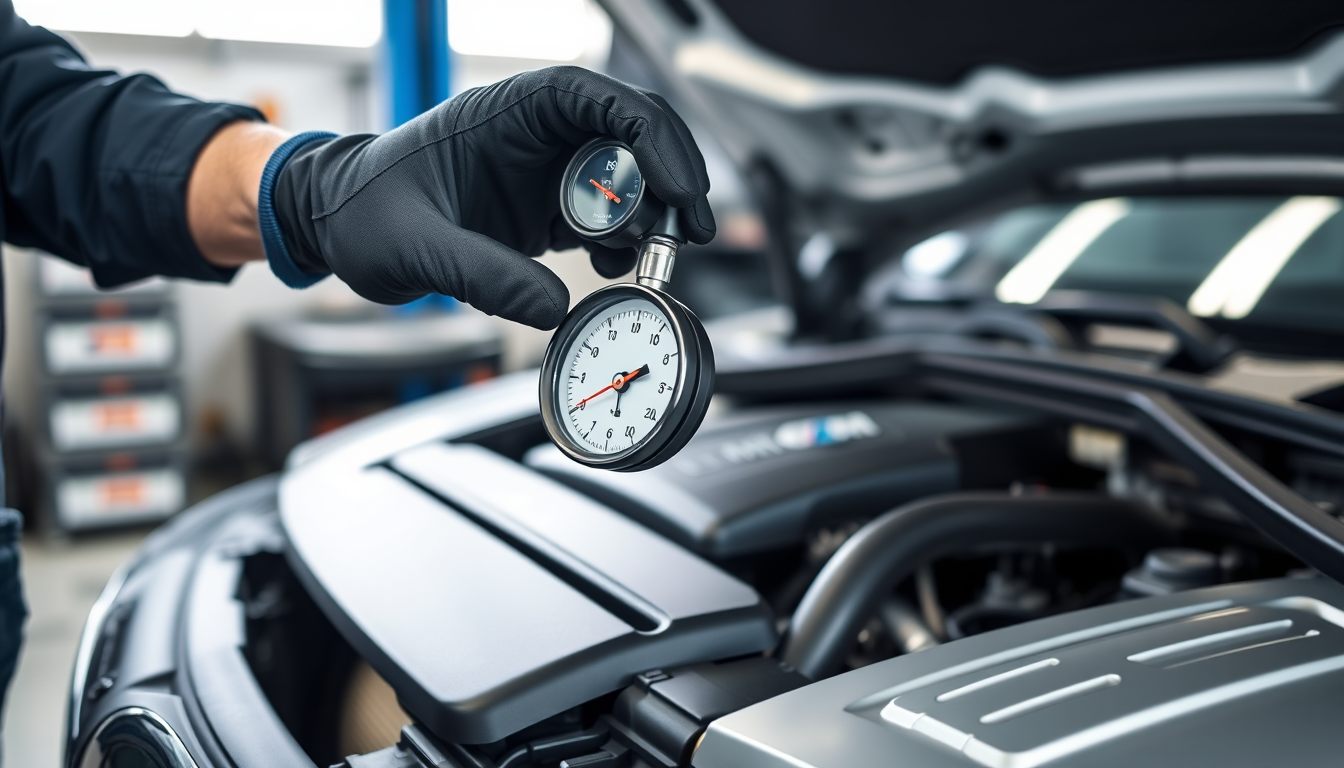
European car AC blowing warm in the middle of a Santa Clarita Valley July isn’t a small annoyance. It’s a real problem, and it has a short list of causes. On the vast majority of Porsches, BMWs, Mercedes-Benzes, Audis, and exotics we see at R2 Motorsports, warm air at the vents traces back to one of three things. A dying compressor. A condenser punctured by road debris. Or a slow refrigerant leak seeping out at the o-rings. We’ll walk through how to tell them apart. Then we’ll cover what happens if you keep driving on it.
Key Takeaways
- Warm AC almost always means the compressor has failed, the condenser is physically damaged, or refrigerant has leaked out through aging o-rings or the compressor shaft seal.
- Nearly every new car sold for the European market since 2017 uses low-GWP R-1234yf refrigerant, not the older R-134a, because of the EU’s Mobile Air Conditioning Directive (Fluorocarbons.org, 2017).
- As of model year 2025, the EPA’s AIM Act rule caps refrigerant GWP at 150 for new light-duty vehicles sold in the US too. R-1234yf is now standard here as well (EPA, 2023).
- Simply “recharging” a system that’s actually low because of a leak buys you a few weeks of cool air before it’s warm again. Find the leak first.
Why European AC Systems Struggle in Valley Heat
A modern European AC system is a sealed, high-pressure loop. It has zero tolerance for a small leak or a weak compressor once ambient temperatures climb into the 100s. Cabin temperatures on a black Ferrari or a Range Rover sitting in a Valencia parking lot push past what the system was engineered for. Any existing weakness, a slightly soft o-ring, a compressor clutch on its way out, gets exposed immediately. That’s why AC complaints spike every July across Canyon Country, Saugus, Newhall, Stevenson Ranch, and Castaic.
Isn’t it strange that the same car blew ice cold in April? It’s not strange at all. Refrigerant systems fail gradually. Marginal performance in mild weather becomes no performance at all once the compressor has to work harder against higher head pressure. Heat doesn’t cause the failure. It just reveals one that was already underway.
A Dying AC Compressor
The AC compressor is the heart of the system. It pressurizes refrigerant so it can shed heat at the condenser. When its internal clutch, bearings, or pistons wear out, the whole loop stops cycling. You’ll usually hear it before you feel it: a grinding or squealing noise when the AC clutch engages. Air starts cool, then drifts warm within a minute or two as the compressor loses its ability to build pressure.
Compressor failure is common on high-mileage AMG models, M cars, and RS variants. Spirited driving means harder duty cycles on every underhood system. A failing compressor clutch can also seize. Metal debris from a catastrophic internal failure gets pushed downstream into the condenser and expansion valve, which is why we flush the whole system rather than just swapping the compressor. For a proper diagnosis before parts get replaced, our auto diagnostics process checks system pressures on both the high and low side, not just whether the clutch engages.
A Punctured or Corroded Condenser
The condenser sits directly in front of the radiator. That means it takes the first hit from every rock, road debris fragment, and chunk of gravel kicked up on the 14 or the 5 (R & Y A/C Compressors, 2025). A small impact creates a pinhole that leaks slowly over days or weeks. A bigger hit opens a larger hole. The system loses its charge almost immediately, which is why some owners notice warm air appear overnight after a long freeway drive.
Low front-end exotics and lowered performance builds are especially exposed here. Ride height puts the condenser closer to whatever the front bumper doesn’t deflect. Unlike a radiator, condensers run at much higher pressure with thinner aluminum tubing, so soldering or patching a punctured core is rarely a lasting fix. Once a condenser is holed, it gets replaced. The system then gets evacuated, vacuum tested, and recharged to spec.
A Slow Refrigerant Leak at the O-Rings
Most refrigerant leaks aren’t dramatic. They’re slow seepage at the rubber o-rings that seal every joint where a line meets the compressor, condenser, evaporator, or expansion valve. These o-rings dry out, shrink, and crack with age and heat cycling. The compressor’s own front shaft seal, where the clutch shaft exits the housing, is one of the most common failure points in the entire system.
An AC compressor refrigerant leak from a worn shaft seal often shows up as an oily residue on the front of the compressor housing. Refrigerant carries lubricating oil with it as it escapes, so the oil marks the spot. Service port Schrader valves are the other frequent culprit, especially after repeated gauge connections wear the small valve core (Taylor & Francis, International Journal of Refrigeration, 2024). We find these leaks with UV dye. It’s injected into the system, circulated for roughly 15 to 30 minutes with the AC running, then traced with a UV lamp at every joint (CarParts.com, 2024).
Why Recharging Alone Doesn’t Fix It
Adding refrigerant to a system that’s leaking treats the symptom, not the cause. It can also mask a compressor that’s already starving for lubrication. Refrigerant carries the oil that keeps the compressor’s internal components alive. A system that’s been low for weeks may have already done damage that a simple top-off won’t reveal, not until the compressor locks up entirely.
Why does this matter more on a European platform than on an economy car? Parts cost more. Labor is more involved on tightly packaged engine bays. A compressor that seizes can send metal debris through the entire loop, turning a single-component repair into a full system flush. Catching a slow leak early, before it becomes a seized compressor, is the cheaper outcome every time.
R-1234yf and Why You Can’t Just Use the Old Refrigerant
Nearly every car built for the European market since 2017 runs on R-1234yf, not the R-134a used in older vehicles. The reason is regulatory: the EU’s Mobile Air Conditioning Directive capped refrigerant global warming potential at 150 for new type-approved vehicles (Fluorocarbons.org, 2017). R-1234yf carries a GWP under 1, roughly 99.9% lower than R-134a. The EPA has since followed with its own AIM Act rule, setting a 150 GWP ceiling for US light-duty vehicles starting with model year 2025. This refrigerant transition isn’t just a European quirk anymore (EPA, 2023).
R-1234yf is classified A2L by ASHRAE: mildly flammable, with a burning velocity under 10 centimeters per second. That’s why it requires dedicated recovery equipment and unique service fittings that prevent it from being mixed with R-134a. Federal law backs this up directly. Anyone who services a motor vehicle AC system for payment has to be trained and certified under Section 609 of the Clean Air Act (EPA, 2024). That’s not paperwork for its own sake. It’s what keeps a refrigerant swap from turning into a hazard.
For Porsches specifically, our Porsche service team works on everything from 911s to Cayennes and Panameras. AC diagnostics get scoped to the platform’s specific compressor and refrigerant type. The same applies across our BMW, Mercedes, and Audi programs. For Ferraris, Lamborghinis, and McLarens, we handle AC work through exotic auto repair, where components are often buried deeper in the chassis and take more care to access.
Preventing the Next Warm-AC Summer
Running the AC year-round, even in winter, keeps the compressor’s internal seals lubricated and less prone to drying out and cracking. A system that sits idle for months is more likely to develop a slow o-ring leak than one that’s cycled regularly. Catching a small leak during a routine visit costs far less than diagnosing a dead system in August.
That’s part of why AC performance is worth checking at every visit, not just when it’s already warm out. Our factory scheduled maintenance service includes a look at AC system health on European and exotic platforms. A developing leak gets caught on a lift instead of on the side of the 5 in July.
If your European or exotic car’s AC is blowing warm and the symptoms above sound familiar, that’s worth a proper diagnosis rather than a guess. Give R2 Motorsports a call at 661-251-3278. We’ll get it on the machine, find the actual failure point, and fix the cause instead of just topping off the charge.
Frequently Asked Questions
Why is my European car’s AC blowing warm all of a sudden?
A sudden shift from cold to warm air usually points to a compressor that just failed, or a condenser that took a hit from road debris and lost its charge quickly. A gradual fade from cold to warm over days or weeks is more typical of a slow refrigerant leak at an o-ring or the compressor shaft seal.
Can low refrigerant alone cause the AC compressor to fail?
Yes. Refrigerant carries the lubricating oil that keeps the compressor’s internal components moving. A system that’s been running low for an extended period can starve the compressor of lubrication. That can lead to a seizure that wouldn’t have happened with a properly charged system.
Is it safe to keep driving with warm AC in Santa Clarita Valley summer heat?
It’s safe for the car, but not comfortable, and it’s worth diagnosing quickly. If the cause is a punctured condenser or a failing compressor clutch, continuing to run the AC can push metal debris or contamination further into the system. That adds cost to the eventual repair.
Why do newer European cars use R-1234yf instead of R-134a?
The EU’s Mobile Air Conditioning Directive required all new type-approved vehicles to use a refrigerant with a global warming potential under 150 starting in 2017. R-1234yf was the refrigerant nearly every manufacturer selected to meet that standard (Fluorocarbons.org, 2017). The US now has a similar requirement for model year 2025 and later light-duty vehicles.
Can I just add refrigerant myself if my AC is blowing warm?
You can, but it treats a symptom rather than a cause. If the system is low because of a leak, a DIY top-off will fade again within days or weeks. R-1234yf also requires certified recovery equipment to handle safely, given its A2L mild-flammability classification, which isn’t something a canister from the parts store accounts for.