

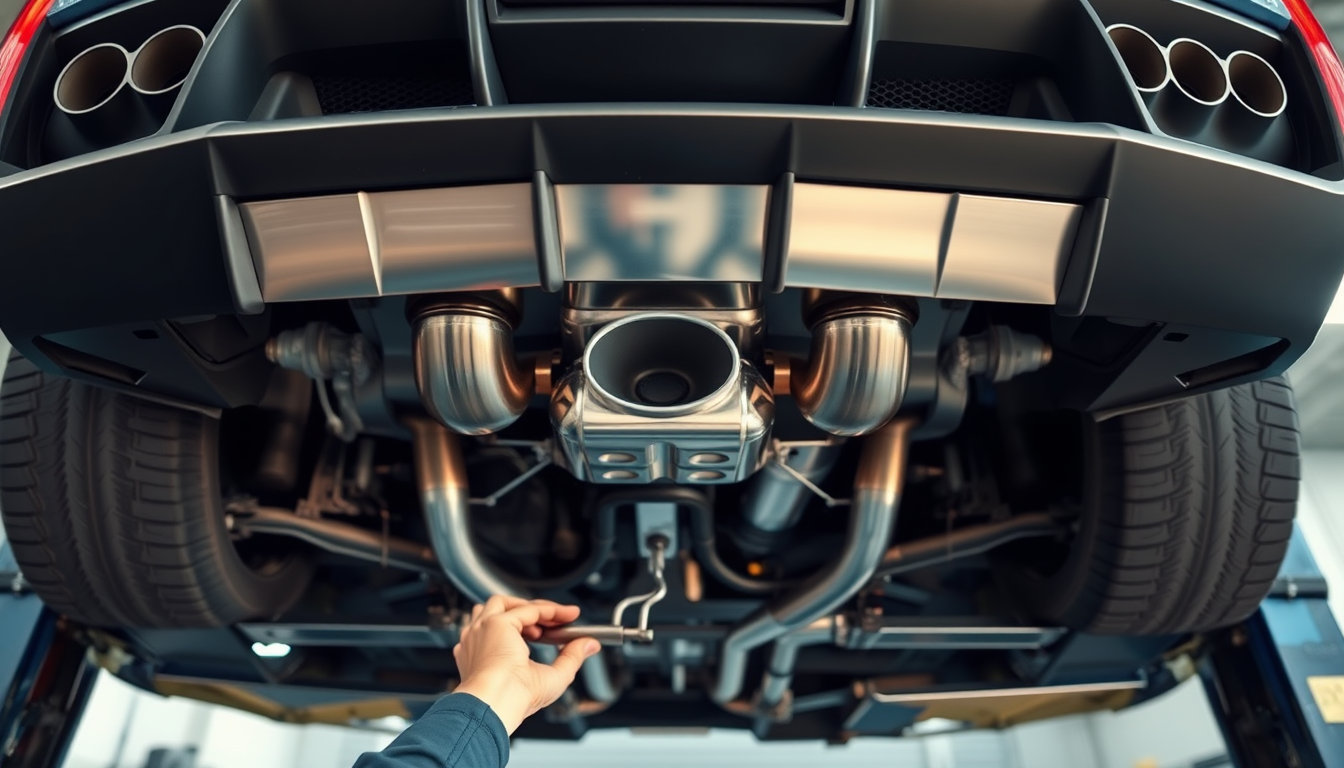
If you’re shopping for an aftermarket exhaust for a Porsche, an AMG, or an M car in the Santa Clarita Valley, you’ve probably seen the phrase “CARB Legal Exhaust” on every product page. It sounds simple. It isn’t. Getting it wrong on a car this valuable can mean a failed Smog Check, a Referee visit, or a part you have to pull back off. Here’s what that label actually covers, and what it doesn’t.
Key Takeaways
- A CARB Legal Exhaust carries a CARB Executive Order (EO) number. That’s a certification issued after CARB determines the part won’t increase emissions (CARB).
- California’s anti-tampering law, Vehicle Code 27156, requires an EO exemption for add-on or modified emission-related parts. True replacement parts that are functionally identical to stock don’t need one (FindLaw, CVC 27156).
- An EO number doesn’t cover noise. Vehicle Code 27151 separately caps exhaust noise at 95 dBA or less for vehicles under 6,000 pounds GVWR, tested to the current SAE International standard (FindLaw, CVC 27151).
- You can verify any EO number yourself through CARB’s own Aftermarket Parts Database before you buy (CARB Aftermarket Parts Database).
What Does “CARB Legal Exhaust” Actually Mean?
A CARB Legal Exhaust is one covered by a CARB Executive Order. That’s the certification number the California Air Resources Board assigns after an aftermarket part passes an engineering evaluation showing it won’t increase emissions (CARB, Aftermarket, Performance, and Add-on Parts). That EO is what exempts the part from the state’s anti-tampering law. Without it, installing certain aftermarket exhaust components is technically a violation, whether or not the car passes a visual check that day.
The underlying law is Vehicle Code 27156. It prohibits installing an add-on or modified emission-related part unless CARB has exempted it. Parts that are true replacements, functionally identical to what came from the factory, don’t need their own exemption (FindLaw, CVC 27156). That gap between “modified” and “identical replacement” is where a lot of exhaust shopping goes wrong, especially on platforms where the factory system already does a lot of emissions work.
How Do You Verify an EO Number Before You Buy?
Check the number directly against CARB’s own records, not just the manufacturer’s marketing copy. Every EO part should carry an Aftermarket Parts Label with a number a Smog Check station, a BAR Referee station, or CARB itself can verify (CARB). CARB also runs a public lookup tool, its Aftermarket Parts Database. You can search it by EO number, part number, or manufacturer before you commit to a purchase (CARB Aftermarket Parts Database).
Why bother checking twice? Because a listing on a seller’s website doesn’t guarantee the EO actually applies to your specific chassis and engine code. An EO is issued for particular vehicle applications, not for “European cars” generally. On our diagnostic bench, we’ve seen exhaust hardware sold as a direct fit for a platform when the EO on file only covered an earlier model year. If your car is on our diagnostics lift for anything else, it’s worth having us confirm the part number while it’s already up.
- Find the EO number on the part’s Aftermarket Parts Label.
- Search that number in CARB’s Aftermarket Parts Database and confirm it lists your exact chassis and engine code.
- If the part isn’t listed or the application doesn’t match, ask a Smog Check station or BAR Referee station to verify it before it goes on the car.
Does Every Exhaust Component Need Its Own EO Number?
Not necessarily, and this is where owners get tripped up. VC 27156 targets emission-related parts that are add-on or modified, not simple replacement parts that don’t touch the emissions system (FindLaw, CVC 27156). In practice, components upstream of or replacing the catalytic converters, like headers or aftermarket cats, tend to draw the closest scrutiny. They sit inside the emissions system itself. A muffler or resonator downstream of the factory catalytic converters is a different question. The honest answer is that it depends on exactly what the part replaces and whether it disturbs any factory emissions hardware.
We won’t pretend there’s one universal rule that covers every Porsche, Ferrari, and M car equally, because there isn’t. The safest move on a car in this price range is verifying the specific part number against CARB’s database or asking a Referee station before you install anything. Don’t assume a “cat-back” label settles the question on its own.
What About Exhaust Noise Limits in California?
An EO number and a legal noise level are two separate requirements. Vehicle Code 27151 prohibits modifying an exhaust system in a way that increases noise beyond the state’s limit. For vehicles under 6,000 pounds gross vehicle weight rating, other than motorcycles, that limit is 95 dBA or less, tested to the current SAE International standard (FindLaw, CVC 27151). A part can carry a valid EO and still be loud enough to draw a citation. Both boxes need to be checked, not just one.
| Requirement | What It Covers | Legal Standard |
|---|---|---|
| EO number (VC 27156) | Emissions compliance | Part-specific exemption verified against CARB’s records |
| Noise limit (VC 27151) | Decibel output | 95 dBA or less for vehicles under 6,000 pounds GVWR, SAE International test method |
Ever wonder why some “CARB legal” systems still get pulled over? This is usually why. The EO addresses emissions compliance. It says nothing about decibels. An exhaust shop that only checks one and ignores the other isn’t giving you the full picture. If you’re searching for a muffler shop santa clarita owners actually trust with an exotic, ask them how they check both before they touch the car.
What Happens If Your Exotic Fails Referee or Smog Check Because of Exhaust?
If a Smog Check station flags noncompliant exhaust, or your car is unusual enough that a regular station can’t certify it, it goes to California’s Smog Check Referee Program. Referees handle exactly this kind of case: inspection disputes, engine changes, and hard-to-find emissions parts a typical test-only station isn’t set up to evaluate (Ask the Ref, BAR Smog Check Referee Program). Once a vehicle is brought back into compliance and passes the Referee inspection, the Referee applies a label. That label lets future Smog Checks go through a normal station again.
That process is slower and more of a hassle on a low-production exotic than on a daily driver. Parts availability and documentation simply take longer to sort out. It’s a lot cheaper in time and money to verify the EO and noise compliance before the exhaust goes on than to unwind it after a failed inspection.
Why This Matters More on Porsche, Ferrari, Lamborghini, AMG, and M Cars
These platforms already run sophisticated factory emissions hardware, and an aftermarket exhaust can interact with more than just sound. On a 991 or 992 Porsche, an M3 or M4 BMW, a W205 or W213 Mercedes-AMG, or an RS-badged Audi, the factory exhaust system is tuned to specific back pressure and sensor feedback the ECU expects. Swap in a non-compliant system and you’re not just risking a citation. You can trigger check engine lights, throw the car into a conservative fuel map, or mask a real fault under a code the shop has to chase down.
We see this most often on cars that come in for something unrelated, an engine concern or a routine service visit, where the exhaust turns out to be part of the story. If you own a Ferrari, Lamborghini, McLaren, or a performance Corvette and you’re weighing an aftermarket exhaust, the same logic applies to any exotic or European platform. Verify the EO and the noise rating before it goes on the car, not after.
Frequently Asked Questions
Do I need a CARB EO number for every part of an aftermarket exhaust?
It depends on what the part replaces. VC 27156 applies to add-on or modified emission-related parts. True, functionally identical replacement parts are exempt from that requirement (FindLaw, CVC 27156). Components near or upstream of the catalytic converters draw the most scrutiny. When in doubt, verify the specific part number against CARB’s database before you buy.
How do I look up a CARB EO number myself?
CARB maintains a public Aftermarket Parts Database where you can search by EO number, part number, or manufacturer (CARB Aftermarket Parts Database). A Smog Check station or BAR Referee station can also verify a number for you directly.
Is a “CARB Legal Exhaust” automatically street legal in California?
No. An EO number addresses emissions compliance under VC 27156. Noise is a separate requirement under VC 27151, which caps exhaust sound at 95 dBA or less for vehicles under 6,000 pounds GVWR, tested to the current SAE International standard (FindLaw, CVC 27151). A part can pass one requirement and fail the other.
What happens if my car fails Smog Check because of the exhaust?
Unusual cases, including disputed inspections and hard-to-find emissions parts, go to California’s Smog Check Referee Program for evaluation (Ask the Ref, BAR Smog Check Referee Program). Once the vehicle passes, the Referee applies a label allowing future Smog Checks at a regular station.
Can R2 Motorsports check whether my exhaust is CARB legal?
Yes, if the exhaust question is tied to a concern we’re already diagnosing on your car, whether that’s a check engine light, a fault code, or a pre-purchase inspection. If your Porsche, BMW, Mercedes-AMG, Audi RS, or exotic has an aftermarket exhaust and something doesn’t feel right, call R2 Motorsports at 661-251-3278 or stop by our shop at 31929 Castaic Rd in Castaic and we’ll take a look.
An EO number is a narrow, specific thing: proof that CARB evaluated a part and found it doesn’t increase emissions. It isn’t a blanket promise that a CARB Legal Exhaust is quiet enough to avoid a noise citation, or that it’s the right EO for your specific chassis. Verify the part number, verify the noise rating, and don’t assume a seller’s “CARB compliant” claim has already done that work for you. If you’re not sure where your current setup stands, or you’re deciding between options before an install, give us a call at 661-251-3278 and we’ll help you sort it out before it becomes a Referee visit.
Sources
- California Air Resources Board, “Aftermarket, Performance, and Add-on Parts,” retrieved 2026-09-14, https://ww2.arb.ca.gov/our-work/programs/aftermarket-performance-and-add-parts
- California Air Resources Board, Aftermarket Parts Database, retrieved 2026-09-14, https://ww2.arb.ca.gov/applications/aftermarket-parts-database
- FindLaw, California Vehicle Code Section 27156 (anti-tampering), retrieved 2026-09-14, https://codes.findlaw.com/ca/vehicle-code/veh-sect-27156/
- FindLaw, California Vehicle Code Section 27151 (exhaust noise), retrieved 2026-09-14, https://codes.findlaw.com/ca/vehicle-code/veh-sect-27151/
- Bureau of Automotive Repair, Smog Check Referee Program (Ask the Ref), retrieved 2026-09-14, https://asktheref.org/