
That sound coming from behind you is not your imagination, and it is not the tires. If your M3 or M5 has started to howl on the freeway, whine when you lift off the throttle, or clunk when you pull away from a stop, you are hearing BMW M differential noise. It is one of the most misdiagnosed complaints we see on M cars in the Santa Clarita Valley, and it is one of the few where waiting genuinely costs you money. A noise that starts as a fluid service can end as a full diff rebuild.
So what is actually happening back there, and how do you tell a harmless break-in chatter from a differential that is eating itself? Let’s go through it the way we would with the car on the lift.
Key Takeaways
- A steady howl or whine that changes with speed usually points to worn ring-and-pinion gears or dying bearings, not a quick fix.
- A clunk on take-off on E46 and E9x M3s is the well-known “M clunk,” caused by worn limited-slip clutches and a worn spider-gear shim (RacingDiffs).
- BMW calls the differential oil a “lifetime fluid,” which is misleading. Independent specialists recommend servicing it around 50,000 miles (FCP Euro).
- M limited-slip differentials take 75W-140 gear oil, not the 75W-90 used in open diffs (FCP Euro).
What does BMW M differential noise actually sound like?
BMW M differential noise falls into three buckets, and each one tells you something different. A high-pitched whine or howl that rises and falls with road speed is gear or bearing related. A grinding or skipping noise during slow, tight turns comes from the limited-slip clutch pack. A sharp clunk when you go from coast to power, or when you shift between drive directions, is mechanical lash, meaning something has worn loose inside.
Here is the quick test. Does the pitch track your speed, or does it track engine RPM? Differential noise follows the wheels. If the howl gets worse at 55 mph regardless of which gear you are in, that is the rear end. If it only shows up under load, or only when the diff is cold, that is a clue too. We sort this out during a proper diagnostic inspection before anyone touches a wrench.
Why does a BMW M differential whine?
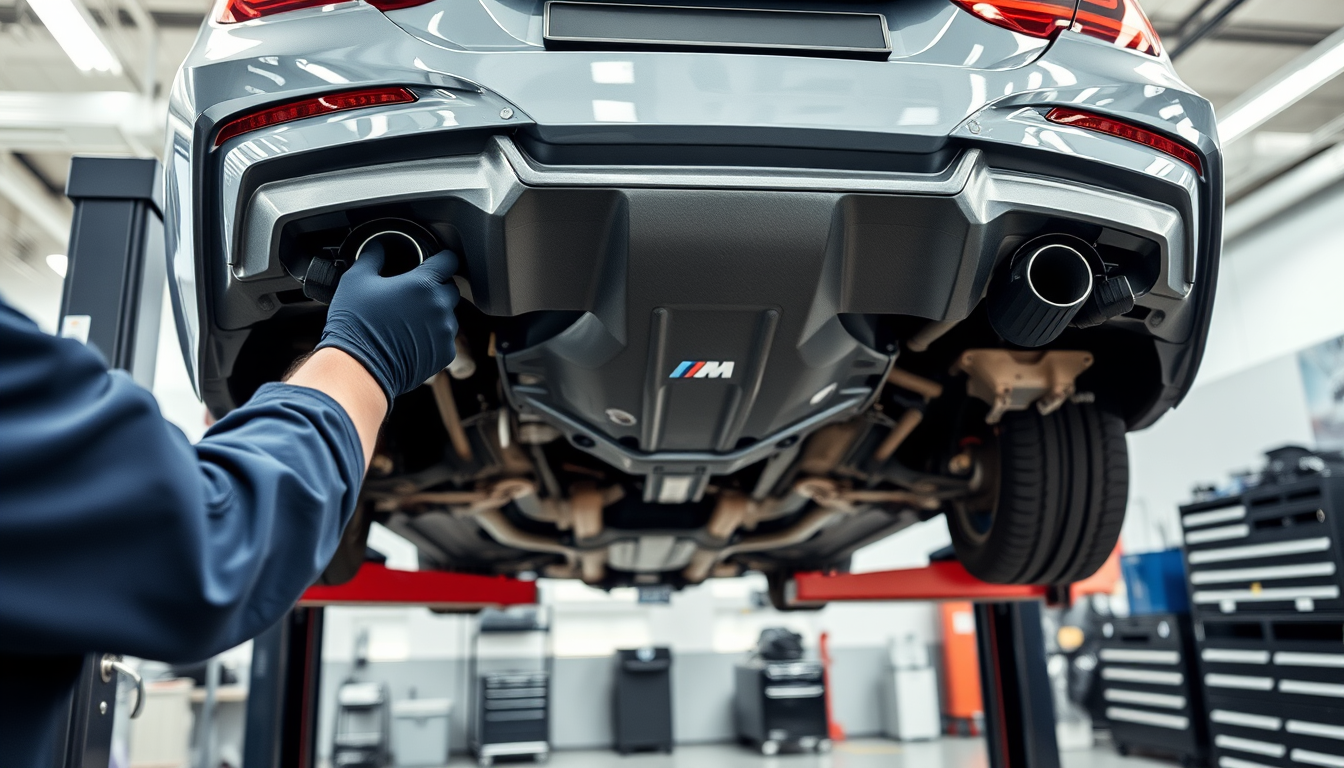
A BMW M differential whine is almost always gears or bearings, and on M cars the differential works harder than the one in any standard 3 or 5 Series. M3 and M5 rear ends use a real mechanical limited-slip unit with a clutch pack, not a simple open diff. The E90, E92, and E93 M3 (the S65 V8 cars) run what Redish Motorsport identifies as a large-case “type 215” limited-slip diff, named for its 215mm crown wheel (Redish Motorsport).
When the gear oil breaks down or the diff has simply covered a lot of miles, the ring-and-pinion teeth and the pinion bearings start to wear. That wear is what you hear as a whine. It usually shows up first as a faint hum on a steady throttle, then grows into a howl you cannot ignore. Worn bearings do not heal. Once a pinion bearing is making noise, the clock is running on the gear set it supports.
There is also the limited-slip clutch behavior to understand. According to BMW’s own service guidance, a grinding noise during tight, slow cornering (think parallel parking, or driving in tight circles) is the slip-stick effect of the clutch discs inside the limited-slip housing. BMW’s documented fix is to replace the differential oil with the friction-modified version, then drive roughly 20 circles in each direction at operating temperature so the special oil coats the locking clutch discs.
See this one on our Instagram (@r2__motorsports)
What does that rear-end clunk mean on an E46 or E9x M3?
If your E46 or E9x M3 clunks when you pull away or change directions, you are almost certainly hearing the “M clunk,” and it is a wear problem inside the limited-slip differential. RacingDiffs explains the mechanism directly: when the clutch plates break in from new, they lose a certain amount of thickness, so the preload drops and the diff starts to slip a bit. The spider-gear shim then wears out quickly and the spider gear ends up with excessive free play, “literally floating in the ledge” (RacingDiffs).
That play is the clunk. Every time torque reverses, the worn parts slap together. RacingDiffs notes the problem typically starts after about 60,000 km from new and is widespread across the E46 fleet. The same grinding and skipping complaint long associated with the E46 M3 is now showing up on E9x M3s as those cars age and pile on miles (Redish Motorsport).
Want to check yours at home? Lift the car safely, grab the rear output flange where the axle bolts on, and try to rotate it back and forth. Compare left to right. If one side has noticeably more rotational free play than the other, that is the M clunk wear pattern. This is the point where a fluid change alone will not save you, and you are looking at a clutch pack and shim rebuild.
Why does the Active M Differential (F80, F90 and newer) fail differently?
Newer M cars do not use a passive clutch diff at all, so they fail in different ways. The F80 M3, F82 M4, F10 and F90 M5, and the G-chassis cars use the Active M Differential, an electronically controlled multi-plate clutch. An electric motor turns a ball-ramp mechanism that compresses the clutch pack, and a control unit varies the locking force using current based on stability-control data, so it can lock before a wheel ever breaks loose (BimmerFile).
Because it is electronically managed, an Active M Differential is normally quiet (BMWBlog). So when one of these starts to whine or clunk, treat it seriously. It still has gears, bearings, and a clutch pack that wear, plus an actuator and wiring that can throw faults. New noise from a normally silent unit is not “character.” It is a symptom, and the diagnosis often needs a scan tool alongside the stethoscope.
Why does ignoring it turn a fluid service into a rebuild?
Differential damage compounds, which is exactly why the cheap fix has a short window. BMW labels the diff oil a “lifetime fluid,” but FCP Euro calls that recommendation “unfortunate” and advises servicing the fluid around 50,000 miles to ensure long component life (FCP Euro). The right fluid grade matters, and it differs by diff type:
- Open differential (front or rear): 75W-90 gear oil (FCP Euro).
- M limited-slip differential (M3, rear): 75W-140 gear oil (FCP Euro).
- BMW noise-complaint oil: SAF-XJ with FM Booster, part number 83 22 2 282 583, a friction-modified 75W-140 for clutch chatter (Redish Motorsport).
Here is the chain of events we see. Old, broken-down fluid stops protecting the clutch pack and the gears. The clutches wear, preload drops, and the diff starts to clunk and slip. Metal from that wear circulates and accelerates damage to the bearings and the ring-and-pinion. What could have been a fluid flush and a clutch refresh becomes a complete teardown with new gears, bearings, and clutches. A fresh fill of the correct 75W-140 on schedule is the cheapest insurance you can buy on an M car rear end.
That noise-complaint oil is BMW’s own answer to clutch chatter and grinding, and it is the right starting point when the noise is mild and the clutches are not yet worn out. Once the clunk and slip have set in, though, no oil will bring back lost preload. At that stage you are paying for parts and labor that a timely fluid service would have prevented.
What should you do when you hear it?
Act on differential noise early, because the diagnosis is cheap and the failure is not. Note exactly when the noise happens: at what speed, under power or coasting, while turning or straight, and whether the diff is hot or cold. That description alone narrows the cause fast. Then get it inspected before more metal goes through the gear set.
For an M car, the work belongs with someone who knows these specific units, the correct 75W-140 fluid, the limited-slip rebuild procedure, and the Active M Differential electronics. That is the bread and butter of independent BMW service done properly, and it is a core part of our wider European auto repair work. If your M3 or M5 is howling, whining, or clunking from the rear, and it matches what you read here, call R2 Motorsports at 661-251-3278 and we will tell you straight whether you are looking at a fluid service or a rebuild.
Frequently Asked Questions
Is some differential noise normal on a BMW M car?
A faint clutch chatter during very tight, slow turns can be normal on a limited-slip diff, and BMW addresses it with friction-modified oil under part number 83 22 2 282 583 (Redish Motorsport). A constant howl, a rising whine with speed, or a clunk on take-off is not normal and should be inspected.
What is the “M clunk” on an E46 or E9x M3?
The M clunk is a take-off clunk caused by worn limited-slip clutches and a worn spider-gear shim. As the clutches lose thickness the preload drops, the spider gear gains free play, and torque reversals make it clunk. RacingDiffs reports it typically starts after about 60,000 km from new.
How often should I change my BMW M differential fluid?
BMW lists the differential oil as a “lifetime fluid,” but FCP Euro calls that misleading and recommends servicing it around 50,000 miles for long component life. M limited-slip differentials take 75W-140 gear oil, not the 75W-90 used in standard open differentials.
Can a fluid change fix BMW M differential whine?
If the noise is mild and the clutches are not worn out, fresh friction-modified fluid can quiet clutch grinding, and BMW recommends driving roughly 20 circles in each direction at operating temperature afterward. A true gear or bearing whine, however, means hardware wear that fresh fluid cannot reverse.
Why is my F80 M3 or F90 M5 differential making noise when it was always quiet?
Those cars use the Active M Differential, an electronically controlled clutch that is normally quiet (BimmerFile, BMWBlog). New noise from a silent unit signals worn gears, bearings, or clutches, or an actuator fault, and usually needs both a mechanical inspection and a diagnostic scan to pin down.
Sources
- RacingDiffs, “Is M clunk from the E46 M3 diff normal and how to solve it,” retrieved 2026-05-28, https://racingdiffs.com/blogs/news/is-m-clunk-from-the-e46-m3-diff-normal-and-how-to-solve-it
- Redish Motorsport, “E90 E92 E93 M3 Limited Slip Diff (LSD) Fluid,” retrieved 2026-05-28, https://www.redish-motorsport.com/E90E92E93M3LimitedSlipDiffLSDFluid.html
- FCP Euro, “BMW Transmission, Transfer Case, & Differential Fluid Specifications (E90/E82/E84),” retrieved 2026-05-28, https://www.fcpeuro.com/blog/bmw-transmission-steering-differential-fluid-specifications-e90-e82-e84
- BimmerFile, “The Active M Differential in Detail,” retrieved 2026-05-28, https://www.bimmerfile.com/2011/09/28/the-active-m-differential-in-detail/
- BMWBlog, “BMW M3 and BMW M4 Inside (part 7): The Active M differential,” retrieved 2026-05-28, https://www.bmwblog.com/2014/08/06/bmw-m3-bmw-m4-inside-part-7-active-m-differential/