

Introduction
Your Cayenne’s cabin is still blowing warm at 95 degrees on I-5 through Castaic, and the shop up the street just “recharged it” and sent you on your way. Three days later, it’s warm again. That’s usually the first sign that whoever touched the car either guessed at the charge weight or doesn’t own the machine your car actually needs. AC Repair in Castaic isn’t the job it was ten years ago, and on a newer European car, the refrigerant itself is the reason why. Most shops built around domestic sedans and pickups still run R134a equipment exclusively, while european car air conditioning repair increasingly means R1234yf: a refrigerant with its own fittings, its own oil, and its own rules. If your Porsche, BMW, Mercedes, Audi, Range Rover, or exotic is one of the newer ones, what refrigerant it runs changes how the repair gets done, what it costs, and who’s actually equipped to do it right.
What Is R1234yf, and Why Did European Cars Get It First?
R1234yf is a hydrofluoroolefin refrigerant that replaced R134a in most new vehicles over the last decade, and the driver wasn’t cooling performance, it was atmospheric chemistry. According to the EPA, R134a carries a global warming potential of 1,430 times that of CO2, while R1234yf comes in at just 4. Under the EPA’s Significant New Alternatives Policy program, R1234yf is listed as an acceptable substitute, classified A2L: mildly flammable, but manageable with the right service equipment and safety hardware built into the system itself.
European brands moved first because Europe regulated first. The EU’s Mobile Air Conditioning Directive (2006/40/EC) banned any refrigerant with a GWP above 150 in new passenger cars sold in the EU starting January 1, 2017. R134a’s GWP of roughly 1,430 was never going to clear that bar, so R1234yf became the default across nearly every European manufacturer’s lineup years before the United States caught up with its own phase-in. That regulatory history is exactly why european car air conditioning repair looks different today than it did a decade ago: it’s not a marketing refresh, it’s a deadline your Porsche, BMW, or Mercedes had to meet just to be sold new in its home market.
R134a vs R1234yf: What Actually Changes Under the Hood
Different Fittings, Different Machines
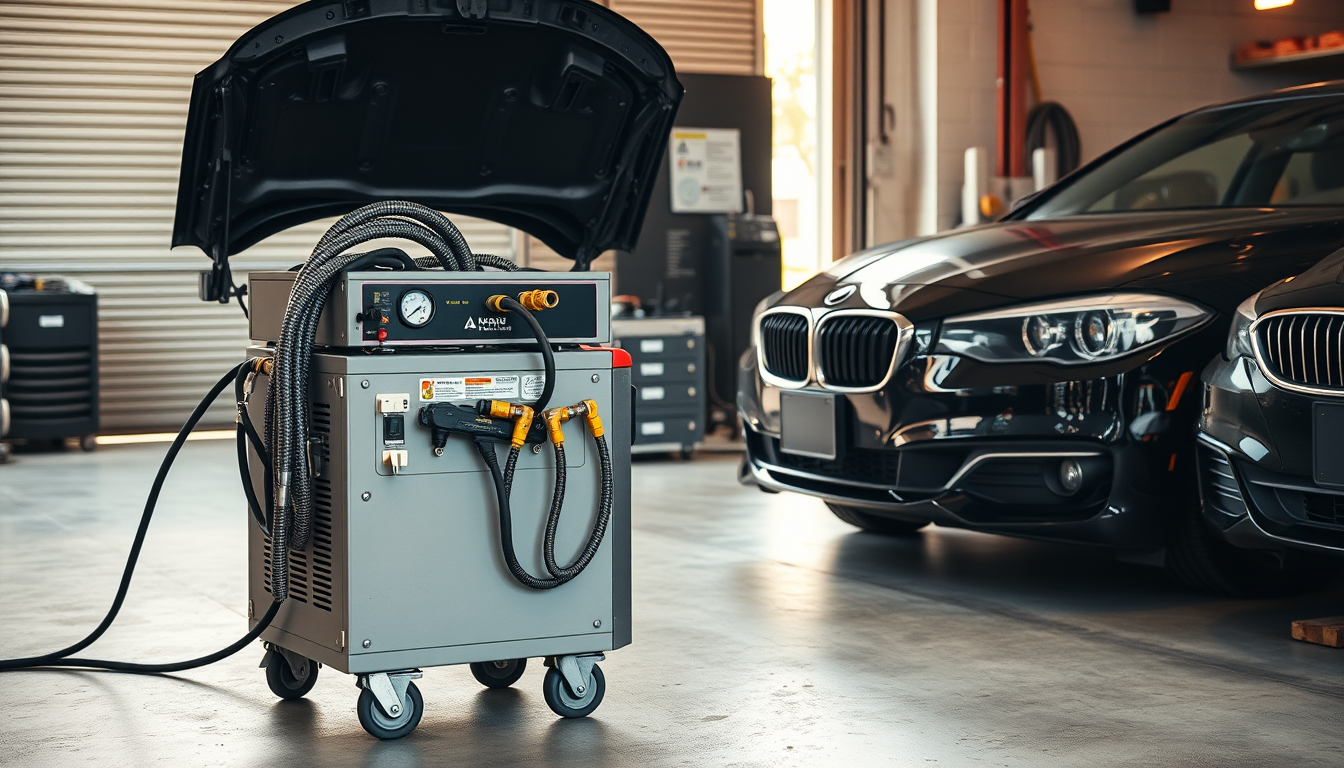
R1234yf systems use service fittings that are physically different from R134a couplers, by design, so a technician can’t accidentally cross-connect the two. You cannot legally, or safely, run an R1234yf car through a shop’s old R134a recovery machine. EPA’s 2021 servicing rule requires any shop charging money for R1234yf service to use certified Refrigerant Recovery and Recycling equipment meeting SAE J2843, J2851, and J3030, and the technician must be certified under Clean Air Act Section 609 regardless of refrigerant. Good shops also run a refrigerant identifier, meeting SAE J2912 or J2927, before ever connecting recovery equipment, since pulling contaminated refrigerant into a clean tank ruins the whole tank, not just that one job.
The Oil Isn’t the Same Oil Anymore
Here’s a detail generalist shops miss: R1234yf systems need PAG oil with a different additive package, not just different refrigerant. Both commonly use PAG 46 as a base oil, but R1234yf-specific PAG carries acid-reducing additives that R134a-spec PAG doesn’t. Run old-spec PAG in an R1234yf compressor and you’re inviting decomposition and resin damage over time. The compatibility only runs one direction: R1234yf-rated oil works fine in an older R134a system, but R134a oil should never go into an R1234yf system. It’s a quirk that doesn’t show up on a parts invoice, only in a comeback six months later.
Why Newer European Cars Need R1234yf, Model by Model
Porsche: Don’t Assume by Generation
It’s well documented in Porsche circles that refrigerant type isn’t even consistent within a single generation. Some 991.2-chassis 911s built in the same 2017 model year left the factory on R134a while others got R1234yf, depending on build date and destination market. That means guessing by generation, or by “it’s a newer 911, it must be yf,” is exactly how a shop ends up cross-contaminating a system. The only reliable source is the underhood refrigerant label. Our Porsche service techs pull that label every time, before a gauge set ever touches the car.
BMW, Mercedes, Audi, and Land Rover Timelines
An F30-chassis 328i running the N20 turbo four, common roughly 2012 through 2015 before the B48 replaced it, typically left the factory on R134a. BMW’s shift rolled out over several years as different platforms hit their EU deadlines, which is why our BMW techs check the label rather than the calendar. Mercedes-Benz’s W205 C-Class, built 2014 through 2021, runs R1234yf. Audi’s B9-generation A4 and second-generation Q5, arriving around 2017 to 2018, moved to R1234yf, while earlier B8.5 cars stayed on R134a; we handle both on the Audi side. Land Rover put R1234yf into the Range Rover (L405) and Range Rover Sport (L494) starting with the 2014 model year. Every one of these has an exception hiding in the build sheet, which is why the sticker under the hood, not the badge, is the only fact that matters.
What This Changes for AC Diagnostics and Repair
A dealer-level scan tool matters more on an R1234yf system, not less. Before a compressor gets condemned, we run the same structured sequence you’d get at the dealer: checking system pressures against the vehicle’s specific charts, verifying the compressor’s commanded state against what it’s actually doing, and confirming there’s no contamination before recovery even starts. That last step matters more than it sounds, since pulling a system down without an identifier check can ruin a shop’s entire recovery tank if a previous owner added the wrong refrigerant. Real AC Repair in Castaic on a modern Euro car starts with that check, not a gauge set. Our auto diagnostics process treats it as a mandatory first step, not an optional upsell.
Common AC Failure Symptoms on Performance and Exotic Euro Cars
Mid-engine exotics have their own failure pattern. A Ferrari 488 or McLaren 570S carries its AC condenser up front, ahead of the cabin, so it takes the brunt of road debris and low-speed parking contact that never reaches the compressor. A slow leak that reads “cold in the morning, weak by afternoon” is often a stone-punctured condenser fin, not a failing compressor, and it’s a case where european car air conditioning repair looks nothing like the same job on a sedan. On sedans and SUVs, the more common complaint is a compressor cycling rapidly or a clutch that engages but never builds pressure, both pointing toward a low charge (never assume, weigh it) or a bad pressure sensor. Musty cabin odor on start-up is almost always the evaporator core or cabin filter, not the refrigerant, and no refrigerant type fixes that. If your exotic’s condenser has taken a hit, our exotic auto repair team can source and fit it without the dealer’s lead time.
Why R1234yf Service Costs More Than It Used To
Three things stack on top of each other here. R1234yf itself runs several times the cost per pound of R134a, full stop, because it’s a newer, more complex molecule produced by fewer manufacturers worldwide. Second, the certified recovery and recycling equipment a shop needs to legally service it, one that meets the SAE J2843/J2851/J3030 standards and includes a built-in or attached refrigerant identifier, is a real capital investment that older R134a-only carts don’t cover. Third, because these systems are charged to a precise weight rather than topped off by pressure or sight glass, a proper R1234yf service takes a full evacuate-and-weigh cycle, not a quick top-off. None of that is padding. It’s the difference between a recharge that lasts and one that’s warm again by the weekend.
Choosing a Shop for AC Repair in Castaic That’s Actually Equipped
Ask a straightforward question before you book: does the shop own an R1234yf-certified recovery machine, or are they sending your car somewhere else, or worse, improvising. A lot of general repair shops around Valencia, Saugus, and Canyon Country can handle an oil change on a European car and still not own the equipment a flammability-rated refrigerant legally requires. We built our shop around the opposite approach: dealer-level diagnostics and dealer-certified equipment, without dealer service-writer markup. That’s the difference that actually matters for AC Repair in Castaic on anything from a 911 to a Range Rover. For broader coverage beyond climate systems, our european auto repair team runs the same standard across every system on the car.
Maintenance That Keeps R1234yf Systems Out of the Shop
The single best thing an owner can do is run the AC year-round, even in winter, for a few minutes a week. A compressor that sits dormant for months loses lubrication at the shaft seal, which is exactly where slow leaks start. A cabin air filter swap on the interval your owner’s manual specifies keeps airflow across the evaporator where it belongs, and it’s cheap insurance against odor complaints that get blamed on the AC system. If it’s been a while since anything climate-related was checked, fold it into your next visit rather than waiting for a warm-air surprise. That’s the maintenance side of AC Repair in Castaic: catching it before a 100-degree afternoon, not after. Our factory scheduled maintenance visits include a system check every interval.
Quick Takeaways
• Check the underhood refrigerant label before assuming R134a or R1234yf, generation and model year alone aren’t reliable, even within the same Porsche or BMW chassis.
• R1234yf has a GWP of 4 versus R134a’s 1,430, which is why EU regulation forced European brands to adopt it years before the US mandate caught up.
• R1234yf and R134a use different service fittings by design specifically to prevent cross-contamination between systems.
• PAG oil isn’t universal: R1234yf-spec oil has different additives than R134a-spec oil, and only one direction of substitution is safe.
• A proper R1234yf service requires certified recovery equipment (SAE J2843/J2851/J3030) and a refrigerant identifier check before recovery ever starts.
• On mid-engine exotics, a front-mounted condenser is the most common leak point due to road debris, not the compressor.
• Weak or inconsistent cooling almost always calls for a weighed recharge to spec, never a pressure-only top-off.
Conclusion
If your European car is blowing warm, cycling strangely, or just isn’t as cold as it used to be, the refrigerant question isn’t trivia, it’s the first thing that determines whether a repair actually holds. Newer Porsches, BMWs, Mercedes, Audis, and Range Rovers increasingly run R1234yf, with its own fittings, its own oil, and its own certified equipment requirements, and treating it like an R134a job is how a “quick recharge” turns into a comeback. The underhood label settles the question every time; guessing by model year doesn’t. When it comes to AC Repair in Castaic, that distinction is the whole job. If this sounds like what’s happening with your car, give R2 Motorsports a call at 661-251-3278 and we’ll pull the label, run the diagnostics, and tell you straight what it needs. If your issue is something else entirely, that’s a different conversation, but for climate control problems on a European or exotic car, this is exactly what we do every day in Castaic.
Frequently Asked Questions
How do I know if my European car takes R134a or R1234yf?
Check the underhood label, usually on or near the radiator support or the AC compressor itself. It states the refrigerant type and the exact charge weight. Model year is a rough guide at best; as noted above, even cars built in the same year on the same platform can differ.
Can any AC shop legally service my car if it uses R1234yf?
Only if the shop owns EPA-required certified recovery and recycling equipment meeting SAE J2843, J2851, and J3030, and the technician is certified under Clean Air Act Section 609. A shop running only older R134a equipment cannot legally or safely service an R1234yf system.
Why does R1234yf service cost more than it used to for R134a cars?
The refrigerant itself costs several times more per pound, the certified equipment is a significant investment most R134a-only shops haven’t made, and a correct service is a full weighed evacuate-and-recharge rather than a quick top-off.
Is R1234yf safe, given that it’s classified as flammable?
The EPA classifies it A2L, mildly flammable, with a low burning velocity that makes ignition difficult under normal conditions. Vehicles built for it include the required safety hardware, like pressure relief devices and warning labels, and certified service equipment is designed around that classification.
What does AC Repair in Castaic typically involve for a European or exotic car?
It starts with pulling the underhood refrigerant label and running a contamination check, then a full diagnostic of pressures, compressor operation, and leak points before any refrigerant is recovered or added. From there it’s either a leak repair, a component replacement, or a weighed recharge to the exact factory spec, never a guess.
References
US EPA, Acceptable Refrigerants and their Impacts: https://www.epa.gov/mvac/acceptable-refrigerants-and-their-impacts
US EPA, Regulatory Requirements for MVAC System Servicing: https://www.epa.gov/mvac/regulatory-requirements-mvac-system-servicing
Federal Register, Protection of the Stratospheric Ozone: Motor Vehicle Air Conditioning System Servicing: https://www.federalregister.gov/documents/2021/03/24/2021-05363/protection-of-the-stratospheric-ozone-motor-vehicle-air-conditioning-system-servicing
European Commission, Climate Action, Air Conditioning (F-gases): https://climate.ec.europa.eu/areas-action/fluorinated-greenhouse-gases/climate-friendly-alternatives-f-gases/air-conditioning_en
SAE International, Standard J639: https://www.sae.org/standards/content/j639_202312/