

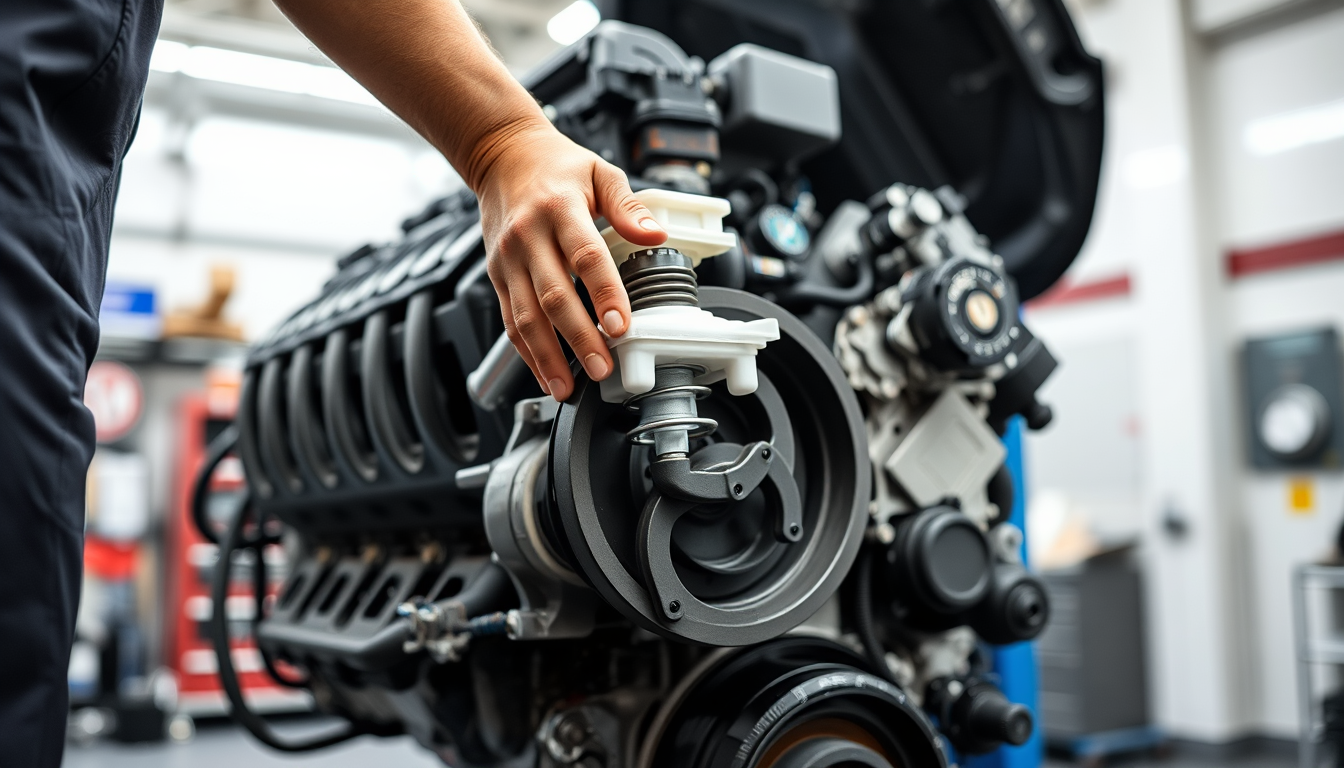
Take the top cover off a BMW, Mercedes-AMG, or Audi V8 and you find something that surprises a lot of owners: most of the cooling system is plastic. A German V8 cooling system runs a water pump, a thermostat and its housing, and a web of coolant pipes and fittings that all live in the hottest part of the engine, and most of those parts are molded polymer rather than metal. That’s fine the day the car leaves the factory. It becomes a problem at 60,000 or 80,000 miles, when years of heat have made the plastic brittle, the seals have given up, and the pump quits without warning. Here’s what actually fails on these engines, in roughly what order, and what a real fix looks like instead of chasing one leak at a time.
Key Takeaways
- Plastic is the common thread. On the Audi 4.2 V8, “the water pump and thermostat housing, as well as a lot of pipes and fittings, are made out of plastic which gets brittle and cracks over time” (Engine Patrol). Nylon-family plastics expand and contract at roughly 10 times the rate of steel, so heat cycling works them loose and cracks them (Components For Industry).
- BMW water pump failure is usually sudden. BMW moved to electric water pumps that “don’t last anywhere near as long as traditional mechanical pumps” and tend to “fail between 60,000 and 80,000 miles,” often with no warning (EuroX Performance).
- The BMW N62 V8 hides a coolant pipe that leaks from the inside. An aluminum transfer pipe runs through the engine valley, its seal fails through electrolysis, and coolant escapes out a small “weep hole” in the timing cover (BimmerFix).
- Thermostats fail stuck, and their plastic housings crack. The Mercedes-AMG 6.2-liter M156 V8 and the Audi 4.2 V8 both go through thermostats, and on the Audi the thermostat “has a tendency to break and get stuck which causes the car to overheat” (Engine Patrol).
- Do it once. Good shops “always replace the pump and thermostat together” because doing anything less is “false economy” once the cover is already off (EuroX Performance).
Why a German V8 cooling system runs on so much plastic
Because plastic is light, cheap, and easy to mold into complex coolant shapes, which helps an engineer chasing fuel economy and emissions numbers. The trade-off is durability, and on a V8 it gets punished hard. These engines pack eight cylinders into a tight bay, they run hot, and the cooling parts sit right in the middle of that heat.
So why does the plastic crack? Heat cycling. Every drive, the cooling system climbs to operating temperature and then cools back to ambient when you park, thousands of times over. The globally accepted spec for underhood temperature is 125 degrees C (257 degrees F), and the plastic in the middle of a V8 lives near the top of that range (Components For Industry). The catch is that “engineering plastics like nylon expand and contract at approximately 10x the rate of steel.” When plastic seals against metal, that mismatch “creates significant interfacial stress” every time the temperature swings, because “the plastic expands outward while the metal insert resists this expansion” (Components For Industry). Do that ten thousand times and the plastic goes brittle, then it cracks.
That single mechanism explains almost everything that follows. The water pump housing, the thermostat housing, the coolant pipes, the little quick-connect fittings: they all age the same way. Which part fails first just depends on which German V8 you own.
BMW water pump failure comes without warning
BMW water pump failure is different from the old belt-driven kind because BMW switched to electric pumps. On most modern BMW engines, the water pump is an electric unit spun by its own motor and controlled by the DME, and BMW made that switch across the range (EuroX Performance). It’s elegant when it works. The problem is that “electric pumps don’t last anywhere near as long as traditional mechanical pumps,” and they tend to “fail between 60,000 and 80,000 miles” (EuroX Performance).
What makes it worse is how they go. A belt-driven pump usually warns you: it weeps, it whines, the bearing gets sloppy for a while first. An electric pump can just stop. As one European specialist puts it, “most BMW water pump failures are sudden. One minute you’re driving, the next the car throws a red warning” (EuroX Performance). The symptoms that show up in that moment are “overheating, the cooling fan running at max speed, reduced engine power, no cabin heat, and temperature warnings” (EuroX Performance). On an aluminum V8, an overheat event is not a minor thing. It’s how head gaskets and warped heads happen.
From our bay at R2 Motorsports, an independent European and exotic repair shop in the Santa Clarita Valley, California: when a BMW V8 comes in for the pump, the thermostat goes with it. The two parts share the same coolant, the same heat, and most of the same labor to reach them. Good shops “always replace the pump and thermostat together,” because putting a fresh electric pump behind a tired thermostat is “false economy” (EuroX Performance). You’ve already paid the labor. Why open it twice?
The plastic coolant pipes and fittings that crack
Some of the worst German V8 coolant leaks aren’t at the pump or the thermostat at all. They’re at a pipe you can’t even see. Two examples show how differently this problem hides on different engines.
The BMW N62 V8 valley coolant pipe
The N62 is BMW’s naturally aspirated V8, used “across many popular BMW models from roughly 2002 to 2010, including the 545i, 550i, 745i, 750i, 645Ci, 650i and X5 SUVs” (BimmerFix). Buried in the V of the engine, under the intake, sits “the internal aluminum coolant transfer pipe that runs through the engine valley and connects the water pump at the front to coolant passages at the rear” (BimmerFix). Its seal fails over time, and “the leak is widely understood to be caused by electrolysis between the aluminum coolant transfer pipe and the aluminum engine block” (BimmerFix).
Here’s the sneaky part. BMW knew the seal would fail, so they built in “a small ‘weep hole’ in the timing chain cover to act as a warning port when the seal fails” (BimmerFix). So the first sign isn’t a puddle under the intake. It’s a small coolant drip near the front of the engine that owners often mistake for a hose or the pump. The traditional factory fix is brutal, because reaching that pipe means pulling the front of the engine apart, and that has produced “repair bills in the seven- to nine-thousand-dollar range and two to three weeks of shop time for full engine tear-down repairs” (BimmerFix). Modern repair pipes now let a shop address it with far less teardown, which is exactly the kind of thing a real diagnosis catches before you authorize the wrong job.
Audi’s plastic pipes and fittings
The Audi 4.2-liter FSI V8, found in cars like the S5, RS4, and S4 of that era, takes the plastic theme to its logical end. On these engines “the water pump and thermostat housing, as well as a lot of pipes and fittings, are made out of plastic which gets brittle and cracks over time” (Engine Patrol). It isn’t one part. It’s a whole family of molded polymer components sharing the same fate, which is why an Audi V8 coolant leak so often turns out to be two or three cracked pieces rather than one. Owners commonly see these failures start around 40,000 to 45,000 miles (Engine Patrol). The parts themselves aren’t wildly expensive. A water pump and thermostat assembly runs “around $400,” although getting it done at an Audi dealer “can easily cost you over $1,000” (Engine Patrol).
Thermostats and their housings: stuck, cracked, or both
A German V8 thermostat fails one of two ways, and both end in an overheat. It can crack the plastic housing it lives in and leak, or the thermostat itself can seize and stop regulating flow. On the Audi 4.2 V8, the thermostat “has a tendency to break and get stuck which causes the car to overheat if the car doesn’t have any coolant leaks” (Engine Patrol). A stuck-closed thermostat is the dangerous one, because it traps hot coolant in the block and the temperature climbs fast.
The Mercedes-AMG side has its own twist. The 6.2-liter M156 V8, badged as the 6.3 AMG and used in cars like the C63, E63, and CLS63 from roughly 2007 onward, is a naturally aspirated monster that made “up to 518hp” (FCP Euro). Its thermostat has a specific enemy: the accessory pulleys. When one of those pulleys fails, “the belt typically damages the coolant breather port on the thermostat,” which means “you will have to replace a thermostat, and thermostat breather line in addition to the drive belt components” (FCP Euro). One failed pulley, and suddenly you’re into the cooling system too.
See the pattern? On a German V8 the cooling parts don’t fail in isolation. A pulley takes out a thermostat. A dead pump has usually been circulating through a tired thermostat for a while. A cracked plastic pipe near a hot pump is often one heat cycle away from the pump seal. This is why we diagnose the whole system, not just the part that happened to leak on your driveway. Sorting that out is exactly what proper auto diagnostics is for.
What a proper German V8 cooling overhaul involves
A real overhaul treats the cooling system as one aging assembly, not a single failed part. On these engines that means replacing the water pump and thermostat as a pair, renewing the coolant pipes and fittings that have gone brittle, checking the housings for hairline cracks, and refilling with the correct coolant and a proper bleed so no air pocket cooks a cylinder head. On a BMW that’s the electric pump plus thermostat as a set (EuroX Performance). On an N62 it may mean the valley transfer pipe while you’re in there (BimmerFix). On an Audi 4.2 it means expecting more than one cracked plastic piece (Engine Patrol).
The reason to bundle it is labor. Most of the cost on these jobs is reaching the parts, not the parts themselves, so replacing one seal today and coming back for the neighbor part in three months means paying that access labor twice. That’s the “false economy” a good shop warns you about (EuroX Performance). Getting it right once is also cheaper than one overheat, which on an aluminum V8 can mean a head gasket or worse.
If your BMW, Mercedes-AMG, or Audi V8 is showing a temperature warning, losing coolant with no obvious puddle, running the cooling fan hard, or giving you no cabin heat, and any of that matches your car, call R2 Motorsports in the Santa Clarita Valley at 661-251-3278. We’ll find where the coolant is actually going and what state the rest of the plastic is in before we replace anything, the way we approach every engine repair, whether it wears a BMW, Mercedes-Benz, or Audi badge. It’s the same standard we hold across European auto repair: diagnose first, fix it once.
Frequently Asked Questions
These are the questions German V8 owners ask us most about the cooling system, from whether it’s safe to keep driving to why the plastic keeps cracking.
Why is my German V8 cooling system built out of plastic in the first place?
Plastic is light, cheap, and easy to mold into complex coolant shapes, which helps fuel economy and cost. The downside is heat aging. Nylon-family plastics “expand and contract at approximately 10x the rate of steel,” so every heat cycle stresses them where they meet metal, and over years they go brittle and crack (Components For Industry). That’s why these parts are reliable when new and a known weak point at higher mileage.
How long does a BMW water pump last?
BMW’s electric water pumps commonly “fail between 60,000 and 80,000 miles,” and they “don’t last anywhere near as long as traditional mechanical pumps” (EuroX Performance). Failure is usually sudden rather than gradual, so many owners choose to replace the pump proactively in that mileage window, along with the thermostat.
What is the BMW N62 weep hole leak?
It’s the early warning for a failing internal coolant pipe. The N62 V8 has an aluminum coolant transfer pipe in the engine valley whose seal fails through electrolysis, and BMW added “a small ‘weep hole’ in the timing chain cover to act as a warning port when the seal fails” (BimmerFix). A small coolant drip near the front of the engine on a 545i, 550i, 745i, 750i, 650i, or X5 is worth checking before it becomes a bigger job.
Can I keep driving with a small coolant leak on my V8?
Only briefly, and only if you watch the temperature closely. The danger with a German V8 cooling system is that a small leak or a sticking thermostat can turn into an overheat quickly, and a stuck-closed thermostat “causes the car to overheat” outright (Engine Patrol). On an aluminum engine an overheat can warp a head or blow a gasket, so it’s worth diagnosing before the smell or the puddle turns into a temperature warning.
Should I replace the thermostat when I replace the water pump?
Yes, on these engines it’s the smart call. The pump and thermostat share coolant, heat, and most of the labor to reach them, which is why specialists “always replace the pump and thermostat together” and treat doing less as “false economy” (EuroX Performance). Paying the access labor once instead of twice is the whole point.
Sources
- Engine Patrol, “11 Most Common Audi S5 Problems (Explained),” retrieved 2026-07-06, https://enginepatrol.com/audi-s5-common-problems/
- EuroX Performance, “Why BMW Water Pumps Fail Every 60K Miles,” retrieved 2026-07-06, https://euroxperformance.com/why-bmw-water-pumps-fail-every-60k-miles-what-drivers-in-golden-colorado-need-to-know/
- BimmerFix, “Inside the BMW N62 Coolant Pipe Design Flaw, Electrolysis, Aluminum, and the Weep Hole Leak,” retrieved 2026-07-06, https://bimmerfix.com/blogs/news/inside-the-n62-coolant-pipe-design-flaw-electrolysis-aluminum-and-the-weep-hole-leak
- FCP Euro, “The Most Common Issues Of The Mercedes-Benz AMG M156 Engine,” retrieved 2026-07-06, https://www.fcpeuro.com/blog/mercedes-benz-amg-m156-engine-common-issues
- Components For Industry, “How Does Thermal Cycling Affect Threaded Inserts in Automotive Plastics?,” retrieved 2026-07-06, https://blog.componentsforindustry.com/how-does-thermal-cycling-affect-threaded-inserts-in-automotive-plastics/