

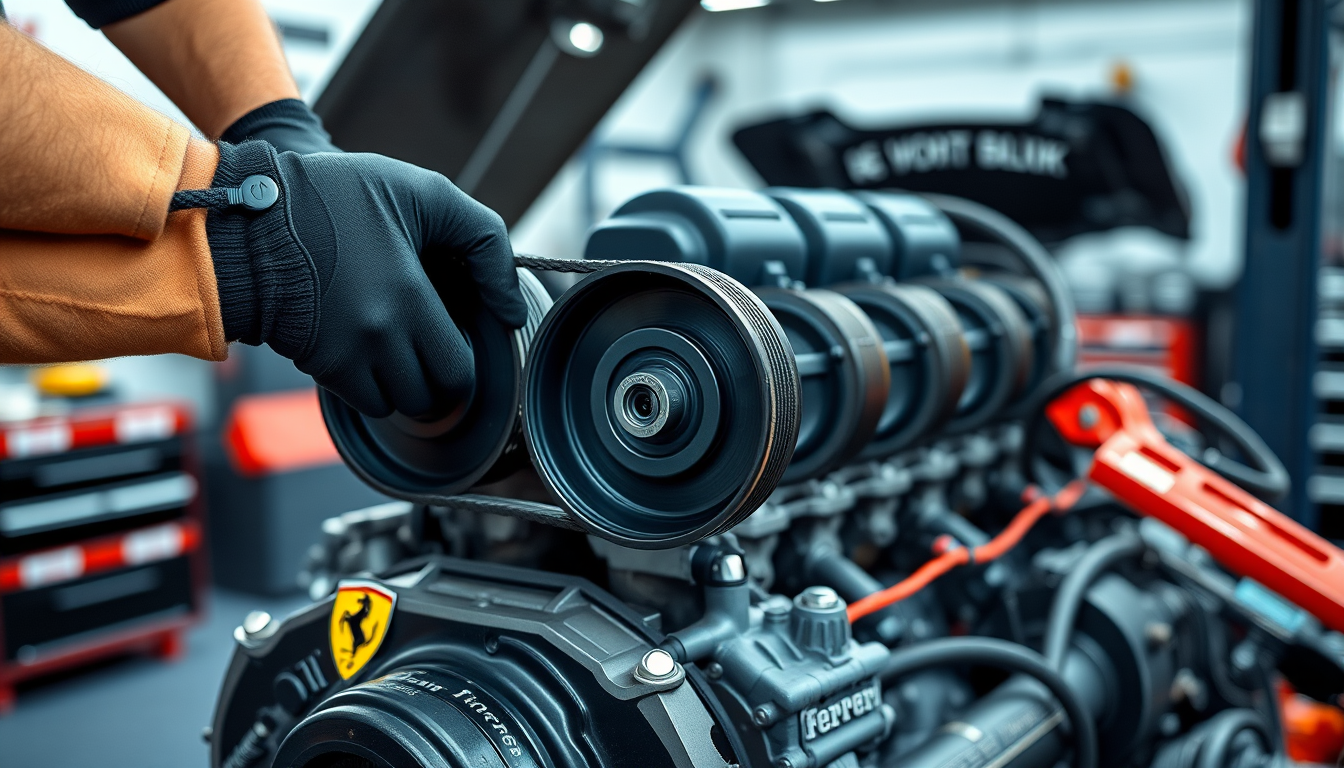
A Ferrari 360 timing belt must be replaced every three years. It is not a maintenance item you get to push to next year. The Tipo F131 V8 in the 360 is an interference engine, which means if that belt lets go, the pistons and the valves try to occupy the same space at the same moment. The result is a destroyed valvetrain and a repair bill that makes the service you skipped look like pocket change. Done on schedule, the belt job is routine. Done late, or done wrong by someone guessing at belt tension, it can end the engine. Below is the real interval, and what a proper job actually involves.
Key Takeaways
- Replace the belt every three years. Magneto’s buying guide says to “budget on replacing the belt every three years,” and Classic Driver puts it bluntly: the belt and its tensioner pulleys must be replaced “every three years without exception” (Magneto, Classic Driver).
- The engine is the Ferrari F131, a 3.6-liter, 90 degree V8 that redlines at 8,500 rpm, and it is an interference design, so a failed belt destroys the valvetrain instantly (Wikipedia).
- Time matters as much as mileage. A garage-kept 360 with low miles and an old belt is still at risk, because rubber ages on the calendar, not the odometer.
- The 360 does not need the engine pulled. An inspection hatch behind the seats lets the belt be changed with the engine in the car (Classic Driver, Magneto).
- A real Ferrari 360 cam belt service replaces the tensioner bearings too, not just the belts. They are a consumable and cannot be inspected with the belts in place (Aldous Voice).
How often should a Ferrari 360 timing belt be replaced?
Every three years. Magneto’s 360 buying guide states it plainly, telling owners to “budget on replacing the belt every three years,” and Classic Driver is blunter still: the timing belt along with its tensioner pulleys “must be replaced every three years without exception” (Magneto, Classic Driver). Owner technical write-ups trace that back to Ferrari mandating new belts every three years across its V8 models, the 360 included (Aldous Voice).
The detail owners miss is that the clock matters as much as the odometer. A toothed rubber belt ages whether the car moves or not, and a 360 that lives in a climate-controlled garage is not exempt. We see low-mileage cars all the time where the seller is proud of 8,000 miles and never mentions that the belt under the cam covers is pushing a decade old. Which one would you actually trust, a number on the dash or a date on the service record?
So when an owner asks about Ferrari 360 cam belt service timing, the honest answer is a date, not a mileage. If you don’t know when the belt was last done, you treat it as due now. There’s no upside to gambling on an interference engine. This is exactly the kind of item that belongs in a real factory scheduled maintenance plan, not the someday pile.
What happens if a Ferrari 360 timing belt breaks?
If the belt breaks or jumps, the engine destroys itself. The 360’s F131 is an interference design, so the moment cam timing is lost the pistons collide with open valves, and Classic Driver flags exactly this risk of “catastrophic engine damage” from the interference layout of the V8 valvetrain (Classic Driver). A belt service is a small fraction of what an engine repair like that costs. Compare the two and the math is not close.
Why does Ferrari run such a tight interval on a part that, in a normal car, might go 100,000 miles? Look at how this engine works. The F131 is a 3.6-liter, 90 degree V8 with a flat-plane crankshaft and titanium connecting rods, and it makes 400 PS (395 hp) right up at 8,500 rpm, which is also where the tach redlines (Wikipedia). A rubber belt whipping around at those speeds, through the heat cycles of a hard-driven V8, does not get the same lifespan as the belt in your daily commuter. The short interval is the price of admission for an engine that sings to 8,500.
The Ferrari 360 does not need an engine-out service
No. This is the single most expensive myth about the car. Owners hear horror stories from the 355 era, where the belt service effectively meant dropping the engine, and assume the 360 is the same. It isn’t. Magneto says it directly: “The dreaded, labour-intensive engine-out cambelt change that plagued earlier mid-engined Ferraris doesn’t apply here,” and the time saved lowers overall maintenance cost (Magneto). The 360 has an inspection hatch behind the seats that lets the belt be replaced without removing the engine (Classic Driver).
In practice the seats come out and the rear bulkhead access is opened so the belt drive, tensioners, and bearings can be reached properly. That’s still a meaningful job, but it is not the engine-out ordeal people brace for. If a shop quotes you for pulling the engine just to do the belts on a 360, that’s a fair sign they don’t live with these cars.
What a proper Ferrari 360 cam belt service includes
A real belt service is more than swapping two belts. The belts are the cheap part. The job is everything you can only reach while the belts are off, plus the parts that quietly fail and take the engine with them. Classic Driver is explicit that the tensioner pulleys get replaced along with the belt, not just inspected (Classic Driver). At R2 Motorsports in Castaic, California, a proper Ferrari 360 cam belt service means the belts, all of the tensioner pulleys, and the tensioner bearings go in as a matched set, never the belts alone.
Tensioner bearings are a consumable, not an inspection item
This is where cars get killed. The tight belt interval exists in part so someone actually checks the hydraulic tensioners, the tensioner bearings, and the tensioner arms, none of which can be properly inspected with the belts in place (Aldous Voice). A seized or rough tensioner bearing will shred a brand-new belt in short order. So you treat the bearings as a consumable and replace them, and many specialists fit higher-quality aftermarket bearings, such as Hill Engineering, rather than reuse the originals (Aldous Voice).
The cam variator check on pre-2001 cars
While the front of the engine is open, an early 360 earns one extra look. The pre-2001 cars suffered premature cam-variator failure, and although it should all have been sorted at dealer level, you confirm the variator campaign was actually done on a pre-2001 car to rule out piston-to-valve contact (Classic Driver, Magneto). Confirming it by history beats assuming it.
The parts you address while you are in there
With the belt drive exposed, the smart move is to deal with the nearby wear items that are cheap now and brutal later. The water pump, the cam seals, and the coolant hoses all live right there, and we go through them while access is open rather than buttoning the car up and going back in six months. Returning because a small seal started weeping next to a fresh belt is the kind of avoidable second visit that makes these cars feel expensive. It isn’t the car. It’s the planning.
The Ferrari 360 belt job done wrong
The uncomfortable truth is that the most dangerous 360 isn’t the one with no service history. It’s the one with a belt “done” by someone who didn’t know the car. On an interference engine, a cam timing error means the pistons meet the valves, and the engine is finished the first time you start it (Classic Driver). Reused tensioner bearings, belt tension set by feel instead of to spec, a tensioner pulley left in place because it “looked fine,” these are the corners that turn a routine service into a grenade with the pin pulled.
We see the redo jobs. A belt that was changed but the tired tensioner bearing left alone. A service record that says the work was done with no detail on which parts went in. When a 360 comes to us with a questionable belt history, we don’t assume, we verify the timing and the hardware before that engine spins under load. The video below walks through exactly one of those situations, a 360 timing belt job that had to be redone.
When to have your 360’s belt looked at
Schedule a Ferrari 360 timing belt inspection if you cannot point to a documented replacement date. The same goes if the car is coming up on three years since the last service, if you just bought it and the history is thin, or if a prior “belt service” has no paperwork listing the tensioner pulleys, bearings, and water pump. On an interference engine, a question mark over the belt is not something you drive on. If that describes your car, call R2 Motorsports, an independent European and exotic auto repair specialist in Castaic, California, at 661-251-3278 and we’ll tell you straight what we find. We treat the 360 as the exotic auto repair it is, and a belt service that protects the engine starts with verifying what’s actually under the cam covers, not guessing.
Frequently Asked Questions
How often should a Ferrari 360 timing belt be changed?
Every three years. Magneto’s buying guide tells owners to budget on it, and Classic Driver states the belt and tensioner pulleys must be replaced every three years without exception (Magneto, Classic Driver). Because the belt ages on the calendar, a low-mileage car with an old belt is still at risk.
Does a Ferrari 360 timing belt service require pulling the engine?
No. The 360 has an inspection hatch behind the seats that lets the belt be replaced with the engine in the car, and Magneto notes the dreaded engine-out cambelt change of earlier mid-engined Ferraris does not apply to the 360 (Classic Driver, Magneto). The seats and bulkhead access come out, but the powertrain stays put.
What happens if the timing belt breaks on a Ferrari 360?
The F131 V8 is an interference engine, so a broken or jumped belt drives the pistons into open valves and destroys the valvetrain, the catastrophic engine damage Classic Driver warns the design is prone to if intervals are ignored (Classic Driver). That is why the service interval is treated as non-negotiable rather than optional.
Should the tensioner bearings be replaced with the belts?
Yes. The hydraulic tensioners, tensioner bearings, and arms can’t be inspected with the belts on, so the bearings are treated as a consumable and replaced during the service, often with higher-quality aftermarket units (Aldous Voice). Classic Driver likewise lists the tensioner pulleys as parts that get replaced along with the belt (Classic Driver). A failing bearing will ruin a fresh belt, so reusing old ones defeats the point of the job.
Do I need to worry about the cam variators on an early 360?
On a pre-2001 car, yes, confirm the factory cam-variator campaign was completed. Early 360s suffered premature cam-variator failure, and verifying the work was done rules out catastrophic piston-to-valve contact (Classic Driver, Magneto). It is worth checking by service history while the belt work has the front of the engine open.
The 360 is one of the most rewarding analog Ferraris ever built, and the belt service is the single clearest line between an owner who stays ahead of the car and one who gets caught out. Know the date your belt was last done. Insist the tensioner pulleys and bearings go in with it. Keep the paperwork that proves it. Stay ahead of that one item and the F131 will reward you for years. If your belt history has a question mark in it, that’s the moment to get a specialist eye on it before it gets expensive.
Sources
- Wikipedia, “Ferrari 360,” retrieved 2026-06-22, https://en.wikipedia.org/wiki/Ferrari_360
- Magneto, “1999-2005 Ferrari 360 supercar buying guide,” retrieved 2026-06-22, https://www.magnetomagazine.com/articles/1999-2005-ferrari-360-supercar-buying-guide/
- Classic Driver, “Don’t buy a Ferrari 360 without reading this first,” retrieved 2026-06-22, https://www.classicdriver.com/en/article/cars/dont-buy-a-ferrari-360-without-reading-first
- Aldous Voice, “Ferrari 360 Timing Belts,” retrieved 2026-06-22, https://aldousvoice.com/2015/08/11/ferrari-360-timing-belts/